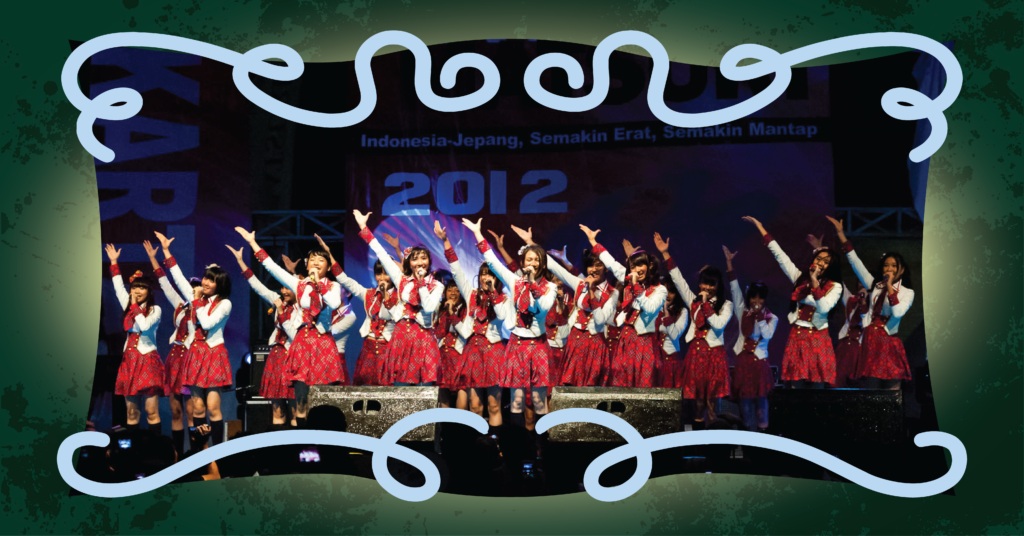
The year is 2011, and AKB48 has been one of Japan’s biggest girl groups — in terms of headcount, sales numbers, and charting songs — for six years now. The Tokyo-based idol ensemble already had a sister group in Sakae, Nagoya, but by the end of that year, would produce three more: two remained within the Japanese borders, but the last one went all the way to Jakarta, Indonesia. By November 2, 28 girls are ready to make their splashy debut, which finally took place on December 17. Thus, JKT48 was born.
Entering their fifteenth year in the Indonesian music industry, JKT48 continue to maintain a thriving fanbase. Even as many of the nation’s girl groups come and go, they remain a stalwart force to be reckoned with. As Southeast Asian girl groups are deservingly getting their time in the spotlight lately, let’s get to know one of Indonesia’s longest-running, as they gear up for an eventful year ahead.
1. The Magic Number
Despite many misconceptions, JKT48 isn’t a 48-member crew. (The number is actually taken from the management company of AKB48’s founder, office48.) Currently, the group consists of 45 regular members and 12 trainees, called kenkyuusei in Japanese, with 11 additional ones unveiled at the climax of their regular theater show on February 14. Usually, members are divided into at least two to three teams, each named after a letter in the group’s name. JKT48 started out with Team J, Team KIII — following AKB48’s Team K and SKE48’s Team KII — and Team T, but this system hadn’t been in place since March 2021.
The headcount changes constantly as girls come and go through ceremonious ways. Auditions to join the group are held every year, while those who choose to leave are treated as graduates. Often, longtime players and key faces of the group even get special single releases and dedicated concerts as part of their send-off package.
Though almost all members are Indonesian, there have been several transfers from AKB48. Haruka Nakagawa and Aki Takajo were among the first arrivals; Chikano Rina followed suit, before Kawamoto Saya did a month-long exchange program with JKT48’s own Stephanie.
2. Idols You Can Meet (and Who Will Come to Meet You)
Following in the footsteps of their older sisters, JKT48 have a concept of “idols you can meet.” It’s a concept traceable back to AKB48 producer and creator Yasushi Akimoto, who wanted to showcase ordinary people who can sing and dance. Behind this approach is a decisive statement to break the streak of unattainable celebrities, instead centering relatability through a process of growth. Fans can follow this by visiting them — on some occasions, they can even personally talk to members through handshake events — but mostly, the girls can be seen on the daily as they put on a show at their permanent theater.
Since April 2018, though, JKT48 put their own twist on that concept, turning it into an “idols who will come to meet you” system. This idea brings the group, who is based in the Indonesian capital of Jakarta, all around the nation through a series of concerts and hallmark events (such as the aforementioned handshakes). It had also spawned temporary offshoots of their theater in major cities like Surabaya and Yogyakarta. These temporary theaters are set to make a return in 2026.
3. Presented by JKT48 and the 48 Girls
Those familiar with the inner workings of the 48 Group would not be surprised at this fact, but no one would’ve guessed that JKT48 Theater can be found inside a shopping mall. Visitors of fX Sudirman in Central Jakarta would know, as from the fourth floor shines a bright marquee, complete with all the fixings of an old-timey, vaudevillian theater. The Art Deco-inspired terrazzo tiled floors, red curtains, and box office look like something you’d find around New York’s off-Broadway district.
As you make your way inside, you’ll be right in the members’ stomping grounds. Clad in black all around, the setup resembles a black box theater. It’s hard to miss a performance here, as showings take place four to five days of the week. Sixteen girls take on the stage each time, doing an Indonesian-language rendition of setlists that their Japanese sister groups debuted in their respective theaters before. The current rotation includes Cara Meminum Ramune (How to Drink Ramune) and Sambil Menggandeng Erat Tanganku (While Holding My Hands Tightly), as well as an original show titled Pertaruhan Cinta (A Bet on Love), comprising songs composed by Indonesian artists.
4. For the Love of Original Songs
Like the theater shows, most of JKT48’s repertoire is built from Indonesian translations of AKB48’s Japanese hits. But, like the theater shows, the group also boasts original singles written especially for them. The first of these came in 2018, when the sub-unit JKT48 Acoustic members Nadila, Rona, Aurel, and Sisca wrote and performed “Lantang” (Loud), a response to them feeling overlooked. It’s more stripped down compared to the flashy productions JKT48 usually puts on, but it’s a showcase of the four girls’ raw musical talents.
The first group-wide original single didn’t arrive until two years later, when “Rapsodi” (Rhapsody) dropped in 2020. This floaty ballad also veers closer toward Indonesian pop sensibilities compared to the J-pop-tinged bubblegum confections of prior releases. Two more original songs followed suit. “Flying High,” the group’s first English-language song, breathes new life into their library as it abandons any semblance to the frilly, uniform costumes they’re known for, instead letting each member shine in their own contemporary dress. The latest, “Magic Hour,” takes the cinematic route that AKB48 has long been lauded for, unveiled across three short movies.
5. International Relations
Although JKT48 are based in Indonesia, their ties to the global network of the 48 Groups elevates their presence to a global audience. Before they even hit their one-month milestone, the group’s founding members had made their debut on the Japanese stage, appearing alongside SKE48, NMB48, and HKT48 at AKB48’s Kōhaku Taikō Uta Gassen concert at Tokyo Dome City Hall on December 20, 2011. This would lead to many more visits to the Land of the Rising Sun, including stints at the coveted main Tokyo Dome stage (where the first transfers of Japanese members were announced), Saitama Super Arena, and Yokohama Arena.As the 48 Group enterprise continues expanding throughout Asia — in Shanghai, Taipei, Manila, Bangkok, Chiang Mai, and Kuala Lumpur — JKT48’s footprints are also charted all over the continent. Select members have appeared on stages in joint concerts in these cities. Alongside members from the local 48 Group, they have created a temporary sub-unit for these shows, WRD48.
However, one member each from JKT48, BNK48 (Bangkok), MNL48 (Manila), and KLP48 (Kuala Lumpur) have come together to create the enterprise’s first permanent global unit. Feni, Fame, Cole, and Mashiro have been performing together as Quadlips, which had its pre-debut at JKT48’s 12th anniversary concert in Surabaya, before releasing their premiere single Catch Me Kiss Me on March 11, 2024 under Superball Inc. Since then, they have released seven more songs, each a departure from the J-pop predilections of the usual 48 Group sound. Instead, Quadlips lean toward the hip hop and R&B side of music, infusing a fresh sound to the enterprise’s catalog.
6. Lights, Camera, Action!
Members of JKT48 are talented in singing, dancing, and performing on stage — that’s almost a given. What many may not know is that several of the girls have acting credits attached to their names. The group’s filmography began in 2014, when VIVA JKT48 debuted in theatres across Indonesia, Singapore, Malaysia, China, Hong Kong, and Taiwan. Eight members from the first and second generations stepped into the main roles as fictionalized versions of themselves who were overthrown by a rival group.
Since then, several members continue to migrate into the acting world. Founding member Nabilah, for example, joined horror film Wewe as supporting actress before leading the romantic drama Sunshine Becomes You against famed actor Herjunot Ali.
Zara, a fifth-generation member, also started acting during her time in the group. She starred in box office titles like Dilan 1990 and its sequel Dilan 1991, Keluarga Cemara (The Cemara Family), and Dua Garis Biru (Two Blue Lines), bringing along other members in cameos and supporting roles. Since graduating in 2019, she has continued to build her thriving career as an actress.
7. The New Era After a NEW ERA
Last December, JKT48 celebrated its 14th anniversary with a concert that coincided with the graduation of its captain, Gracia. Of course, it wouldn’t be a 48 Group concert without major announcements; among them is the group’s new era for 2026.Since 2018, JKT48 have been cycling through eras with taglines that guide their ethos during that time period. The first among them was RE:BOOST, where the “idols who will come to meet you concept” was first unveiled. NEW ERA took over in 2021; this marked the first time membership structures weren’t divided into three teams. This era also saw the release of THIS IS JKT48 NEW ERA, a digital album containing seven rearranged versions of previous releases.
Entering 2026, it’s a new dawn for the group. Their new era, JKT48 FIGHT!, sees seventh-generation member Freya step into the captain role. It also marked the group’s return to the team format, albeit departing from the standard naming practices. Instead, they’re called Team Love, Team Dream, and Team Passion as a reflection of what the members will continue to strive for. “JKT48 wants to show an even bigger spirit for fans and the general public,” explained General Manager Melody Nurramdhani Laksani, who was the group’s founding member and captain until her graduation in 2018. “This concept brings new hope to both members and fans,” added Vice General Manager Shani Indira Natio, who once also held the captain position until her graduation in 2024.
A new song, “Andai Ku Bukan Idola” (If I Weren’t an Idol, an Indonesian version of AKB48’s Idol Nanka Janakattara), kickstarted this era. It will also bring back Request Hour, an annual 48 Group concert where the 30-song setlist would be decided by fan voting. The last time JKT48 held this was an online stream in 2021, and the 2026 edition is slated to take place around the halfway point of the year.
Get Ready to Fight!
With so many exciting developments in the horizon, this is a great time to jump in and explore the deep lore of one of Indonesia’s longest-running girl groups — one that continues to put fan interaction in the center. To follow JKT48’s journey, find them on Instagram, X, TikTok, and their official website! You can also find their music on Apple Music, Spotify, and YouTube.
Looking to get to know more girl groups from Southeast Asia? Check out our breakdown of BINI’s latest album FLAMES and our exclusive interview with Thailand’s 4EVE!