Asian Easter Eggs You Might Have Missed In “Bridgerton” Season 4
This article may contain show spoilers.
Dearest Gentle Reader,
We begin again. With the conclusion of February, the month of love, so ends another season of Bridgerton. This season’s marriage mart followed none other than the second eldest of the Bridgerton household, Benedict Bridgerton. As the Ton reflects upon another riveting tale filled with romance and gossip, one might also note new portrayals of cultural diaspora, with particular emphasis on references from the East. Though many of these details blend into British society, a keen eye and an open mind may allow one to spot subtle, yet significant reflections of culture. Perhaps you might have missed a detail or two, but it is no matter as Envi is here to share a few Asian cultural nods one might wish to be made aware of this season of Bridgerton.
Sophie Baek: Hints of Korean Heritage
Early on, the show established Season 4’s leading lady, Sophie Baek, played by Korean-Australian actress Yerin Ha, to be of Korean descent. Although Sophie is considered a third- or fourth-generation Korean, according to costume designer John Glaser, subtle elements of Sophie’s Korean heritage were able to shine throughout the show. One of the most immediate observations fans noticed was the change in Sophie’s surname from “Beckett” to “Baek.” Yerin Ha, during an interview with InStyle, shared, “One thing I love about Bridgerton is when they incorporate a person’s heritage. The change of Sophie’s last name really came about organically.” Yerin recalls being asked whether there was a Korean surname that started with a B, and suggesting “Baek” as the pronunciation was similar to Julia Quinn’s original “Beckett.”
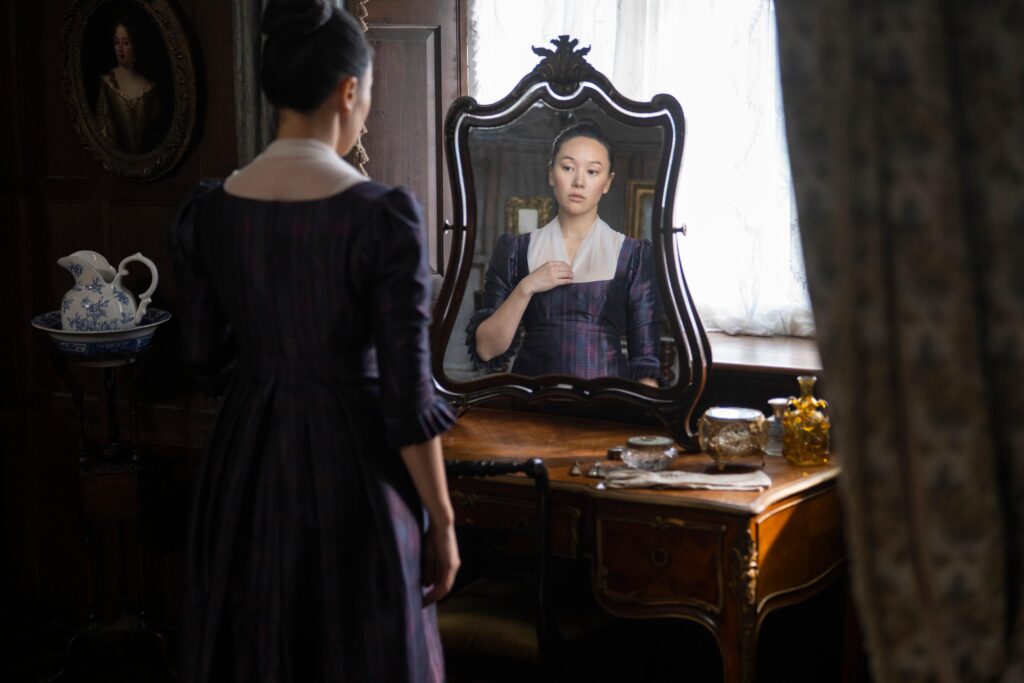
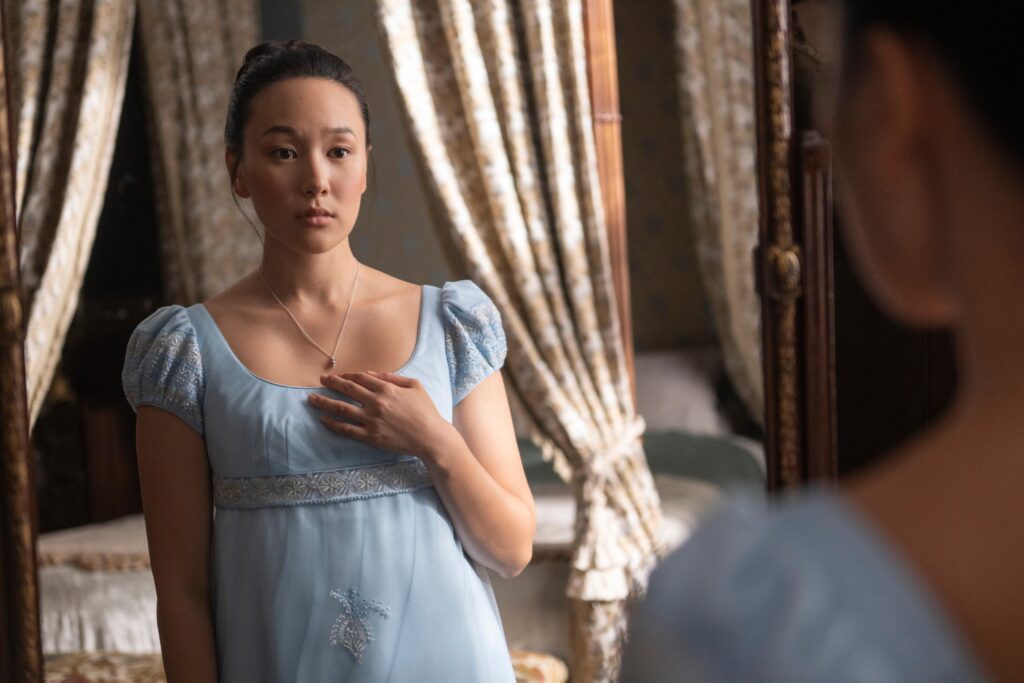
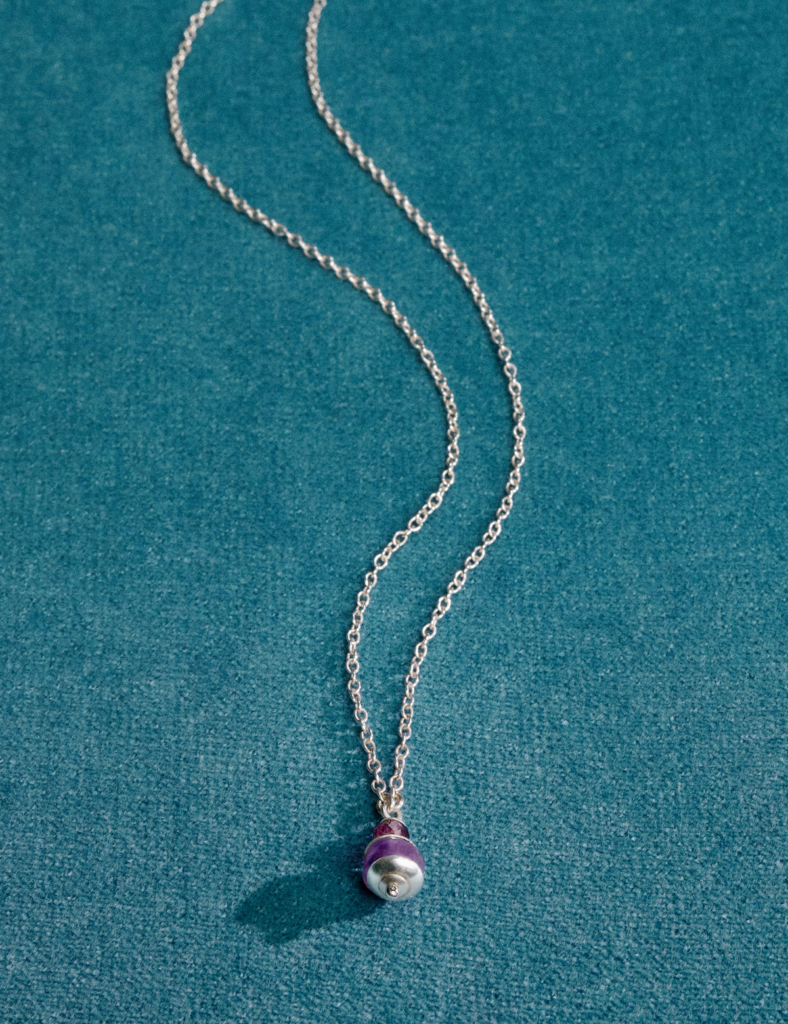
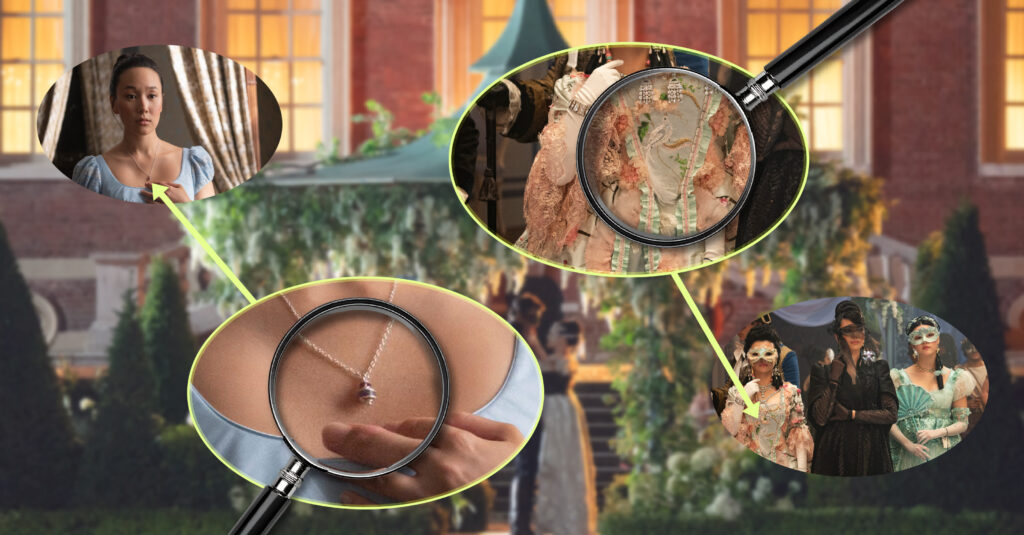
Sophie’s Korean heritage was also reflected in subtle costuming choices throughout Season 4. Though John Glaser, head Bridgerton costume designer, did note “we were not to have any Asian influences because they’re third or fourth generation from the Ton” and assistant costume designer George Sayer adds, “So there was a slight nod.” One detail reflecting Sophie’s Korean background was her heirloom pendant. The necklace did not just symbolize Sophie’s connection to her heritage because it was worn by her mother, but the choice of amethyst by Glaser actually a reference as amethyst is the national gemstone of Korea. Ironically, it also happens to be the representative birthstone for February.
Another small detail featured was the Penwood crest, first seen in the second episode, “Time Transfixed,” as Sophie dresses for the masquerade ball as the Lady in Silver. Her fellow footman and best friend Alfie brings “silver shoes to match,” — a pair of silver shoes from Araminta’s shoe collection with the Penwood family crest stamped on the insole. The motif shows up briefly again when Benedict comes calling to the Penwood estate in search of the mysterious Lady in Silver after finding the Penwood crest embroidered on the inside of one of Sophie’s gloves, left behind at the ball. The Penwood crest appears to feature a golden pheasant, a popular motif in Korean and Chinese culture symbolizing auspiciousness, good fortune, and nobility. The bird is also considered an earthly ancestor of the mythical phoenix (봉황/凤凰) in traditional folklore. Eleanor Ventress, a seamstress, embroiderer, and embellisher, shared an up close image of the embroidered signet on her Instagram, @eleanorventress_seamstress.
The post credits wedding scene also features traces of Korean wedding traditions added by the production designers, referencing Korean wedding traditions. “If you look around, there are pine cones, dates, and chestnuts,” common symbols of loyalty and fertility in Korean culture. “There were little ways of just showing that Sophie had some imprints on having her culture show up in this wedding,” shares Showrunner Jessica Brownell in an interview with Glamour. Most notably was the platter of alternating layers of chestnut and jujube dates seen briefly underneath Benedict’s finished portrait of Sophie at the end. The platter called daechu-bam-goim (대추밤고임) is a common part of traditional Korean weddings. There is even a traditional game where the father-in-law will toss the chestnuts and jujube towards the bride and groom who will try to catch them with either the bride’s skirt or a white cloth. The number of chestnuts and dates caught represent the number of children the couple will have together — jujubes symbolizing sons and chestnuts representing daughters.
Araminta Gun, Rosemund Li, and Posy Li: Chinese Inspirations
Moving on, this season saw the introduction of three new characters to the Ton, the widowed Dowager Countess of Penwood Araminta Gun (Katie Leung) and her two daughters Rosemund (Michelle Mao) and Posy Li (Isabella Wei). Similar to Sophie’s character, the surnames of the stepfamily were adjusted to match the ethnic backgrounds of its actresses — Gunningsworth becoming Gun and Reiling changing to Li. Aside from just a change in names, the Penwood household appears to infuse quite a few traditional Chinese elements into costume design and background props, creating some depth and backstory to these characters.
Araminta’s costume design was designed by John Glasser to reflect a constant state of mourning, leaning heavily into heavy black fabrics, strong silhouettes, and emphasis on the shoulders. Many of her dresses also feature high necklines, subtly mimicking the Mandarin collar structure. Moreover, unlike other characters whose hairstyles often changed throughout the season, Araminta’s hair remains in the same sleek updo with a polished sideswept wave in the front, reminiscent of the popular finger waves, women in Shanghai often wore in the 1920s, a time of rapid westernization that created a blend of Chinese and Western culture in the city.
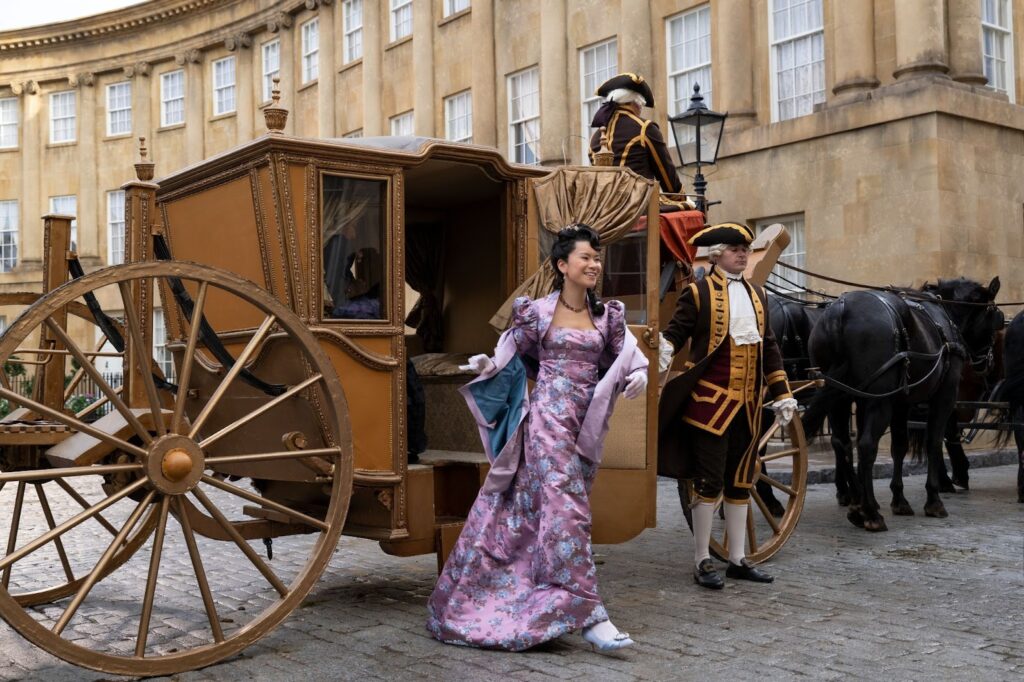
Araminta, before the death of the Earl of Penwood, appears to have worn much brighter colors as seen in Episode 4, “An Offer From a Gentleman.” Here, in her purple dress, though it has a typical regency silhouette marked by the empire waistline under the bust, the fabric of the dress appears to have a silk brocade quality with a painted floral design reminiscent of Chinese painting styles that focus more on fewer brush strokes, and more variations in pressure when painting plant-life.
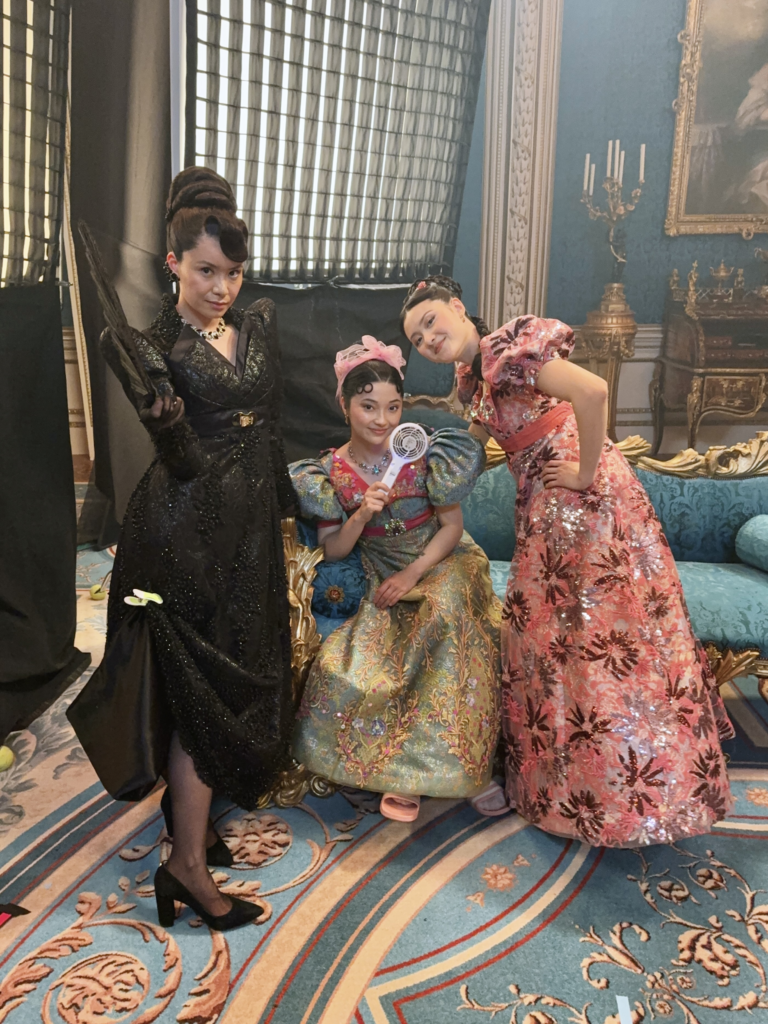
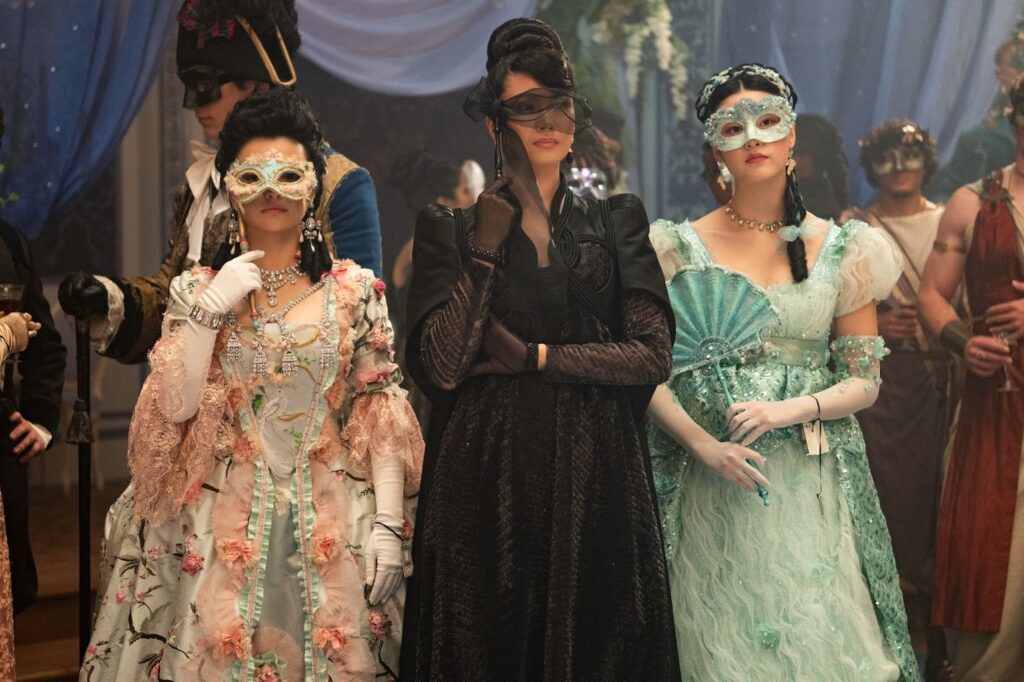
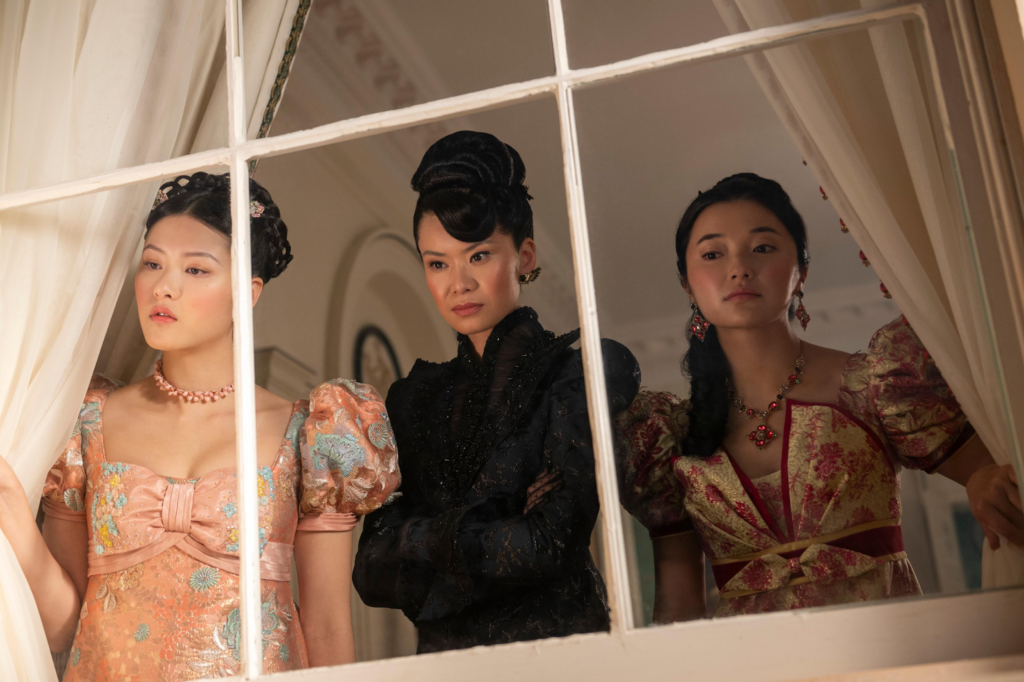
Incorporated details of Chinese culture are also spotted in many of Rosamund and Posy’s outfits. During the masquerade ball, Posy, dressed as a mermaid, is seen with a stylized version of a tuanshan (团扇), a handheld round fan, blended with characteristics of a zheshan (折扇) folding fan. Posy’s fans often feature Chinese patterns on them. As Isabella Wei noted in an interview with Refinery29 Australia, “I had a few fans that had some sort of, kind of Chinese embroidery detail.” Posy’s hairstyles also appeared to be a fusion of Regency era braided styles with looped hairstyles similar to the Tang dynasty, where women of status wore taller, structured hairstyles with hair in multiple loops. Posy also wore hairpins similar to the style and position of zan pins on either side of her head. Wei also references one particular costume “in Episode 2 [the dress] has this kind of qi pao style collar.”
Rosamund’s style generally seemed to include more British Regency style aesthetics compared to Posy. For example, her Marie Antoinette costume uses fabrics with a chinoiserie pattern of cherry blossoms branching across the dress. As chinoiserie patterns were European interpretations of Chinese and broader East Asian aesthetics, it gives a sense of blended cultures. The use of chinoiserie patterns on fabric or embroidered appliques of flowers such as peonies was a common detail seen later in other outfits such as Rosamund’s gold dress with red detailing in Episode 2, “Time Transfixed,” when Benedict Bridgerton comes calling for Posy. During this scene, Rosamund and Araminta can actually be seen very briefly playing Chinese checkers while Posy and Benedict chat, confirmed after its release by Katie Leung in the Refinery29 Australia interview.
Side Characters
The Late Earl of Penwood
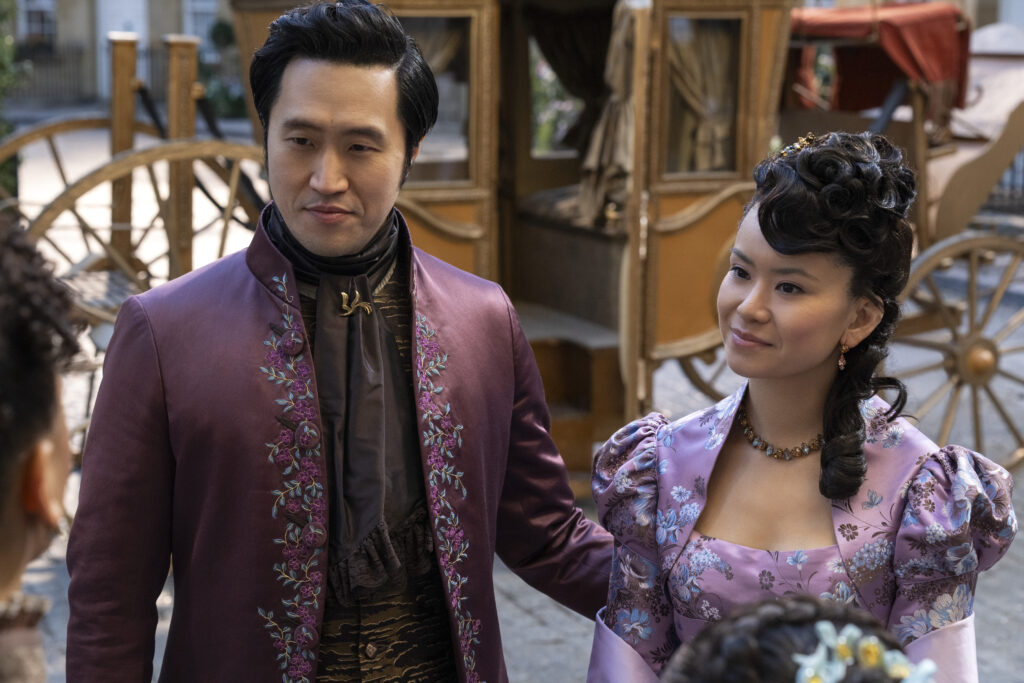
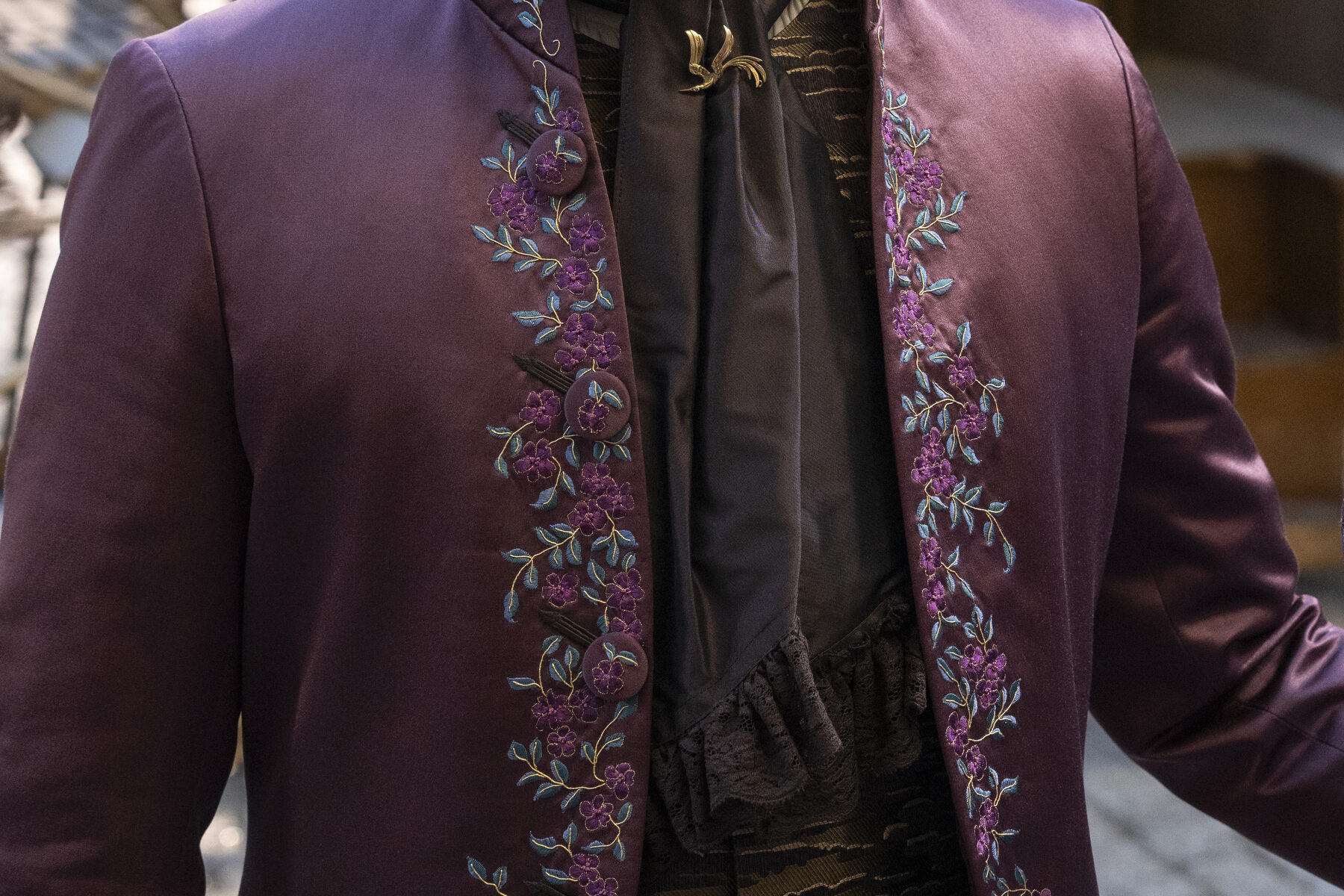
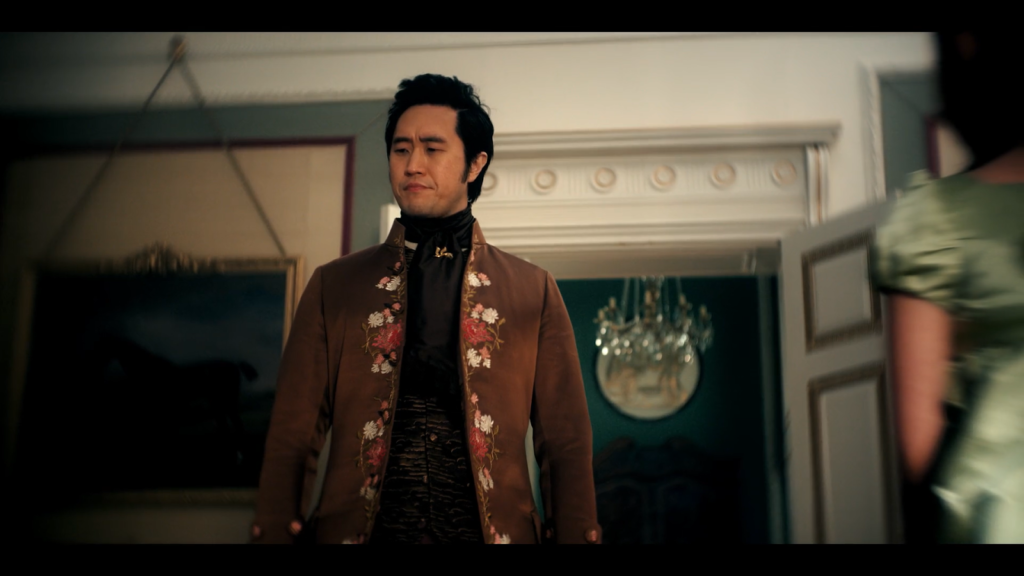
During a short flashback scene of Sophie’s childhood in Episode 4, “An Offer From a Gentleman,” we are introduced to her father, the Late Earl of Penwood (Arther Lee). Though brief, his attire incorporated a myriad of subtle Korean influences including Korean inspired embroidery along the lapels and button facing of his outer coat. Traditional Korean embroidery, in contrast to European embroidery, tends to be flat and smooth, often featuring stylized symbols of nature such as flowers, butterflies, cranes, and clouds. In traditional Korean culture, motifs associated with fortune and longevity were called Sipjangsaeng. Similar to the detailing on his coat, embroidery of clouds designs, meaning elegance (풍류) and calm (여유) can be seen stitched across the Earl’s waistcoat and cummerbund.
Another small detail one might miss is the gold cravat pin, featuring the shape of a Korean pheasant (봉황), consistent with the pheasant detailing displayed earlier in the Penwood crest in the silver shoes and gloves Sophie wears to the masquerade ball.
Viscountess Kate Bridgerton
Long anticipated by many “Kanthony” fans, the Viscountess returned for part 2 of Season 4 from her trip to India, now as a mother. Many remember Kate Bridgerton (Simone Ashley), former leading lady in Season 2, not only for her epic enemies-to-lovers relationship arc with Viscount Anthony Bridgerton, but also for the incorporation of Indian culture and design into her character’s plot and costuming. One again reflecting her heritage, the Viscountess makes a reappearance in Episode 7, “The Beyond,” draped in a blue sari-inspired dress, decorated with a gold floral pattern. In contrast to earlier seasons, we see Kate in similar traditional colors of teal and blue, but in a more draped silhouette to reference her heritage and more muted tones to represent her maturity.
Moreover, her jewelry appears to be loosely inspired by South Indian jewelry as her earrings are on the heavier and chunkier side compared to the thinner and smaller Regency earring designs. The Viscountess also appears to be wearing a gold bracelet cuff reminiscent of a laxmi cuff– a type of South Indian temple bracelet that tends to use multiple links and feature carved images or motifs within each of the links.
Lord Barneby
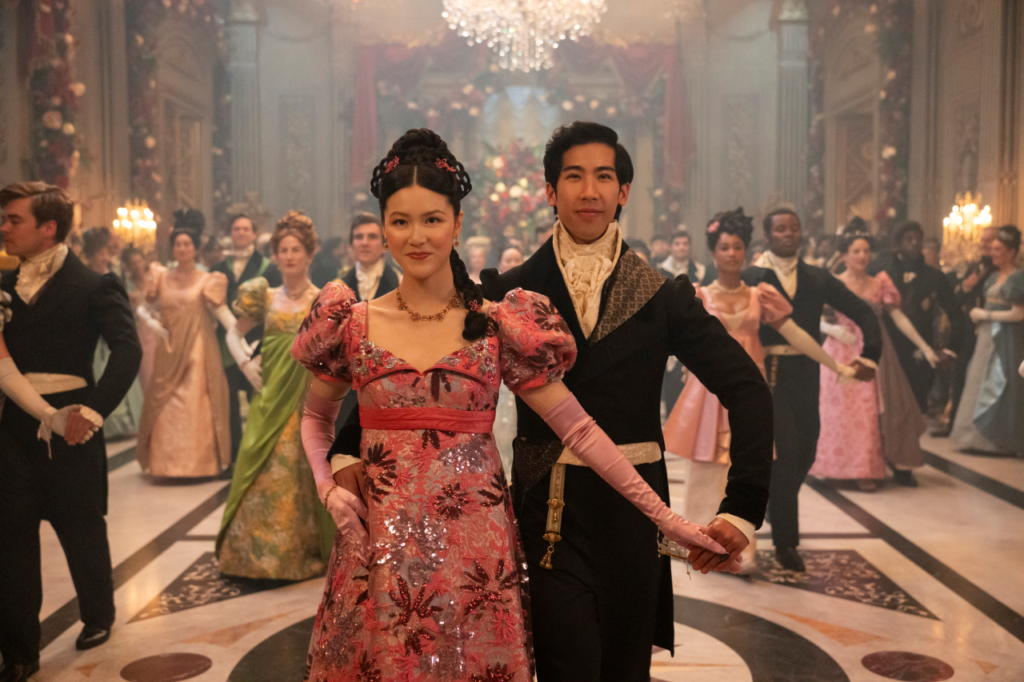
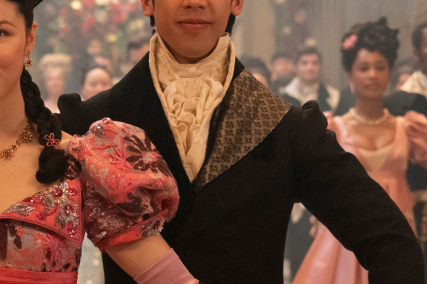
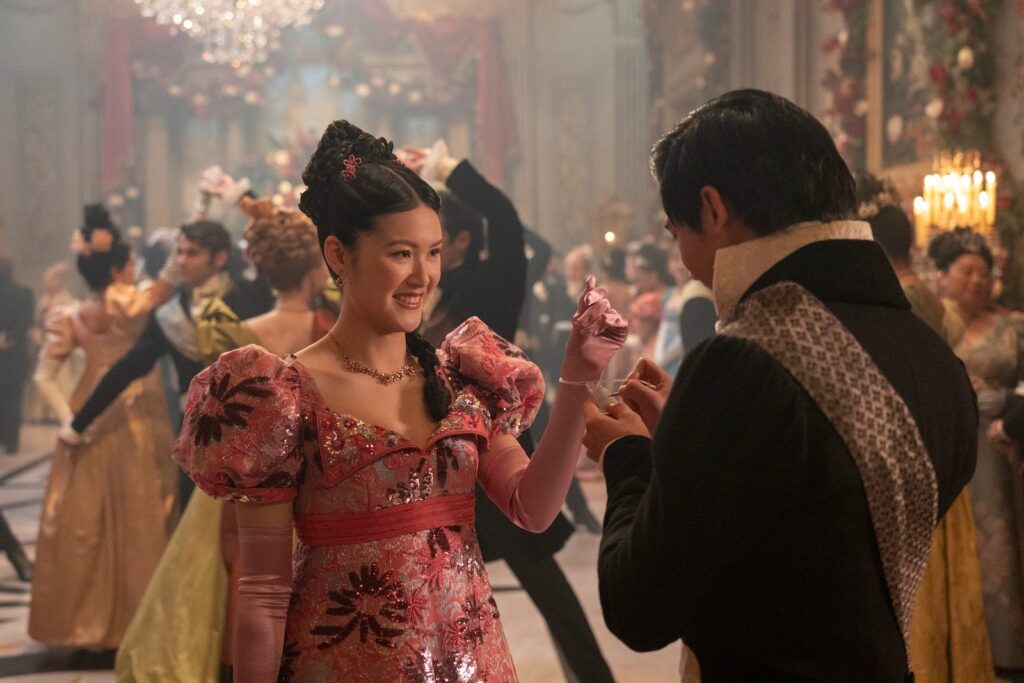
Although his appearance was only for a few minutes in Episode 8, “The Beyond,” Lord Barneby’s (Zheng Xi Yong) costume design garnered quite a bit of attention. During the Queen’s ball, Posy ended up attracting the attention of the fine young Lord Barneby whom many noticed was sporting a Malaysian or Burmese sbai, a traditional shoulder cloth or chest sash, with a batik textile pattern tied into his tailcoat. Many viewers expressed excitement and surprise to see South East Asian representation receive the limelight through its reflection in costume design.
Language, Flowers, and Furniture
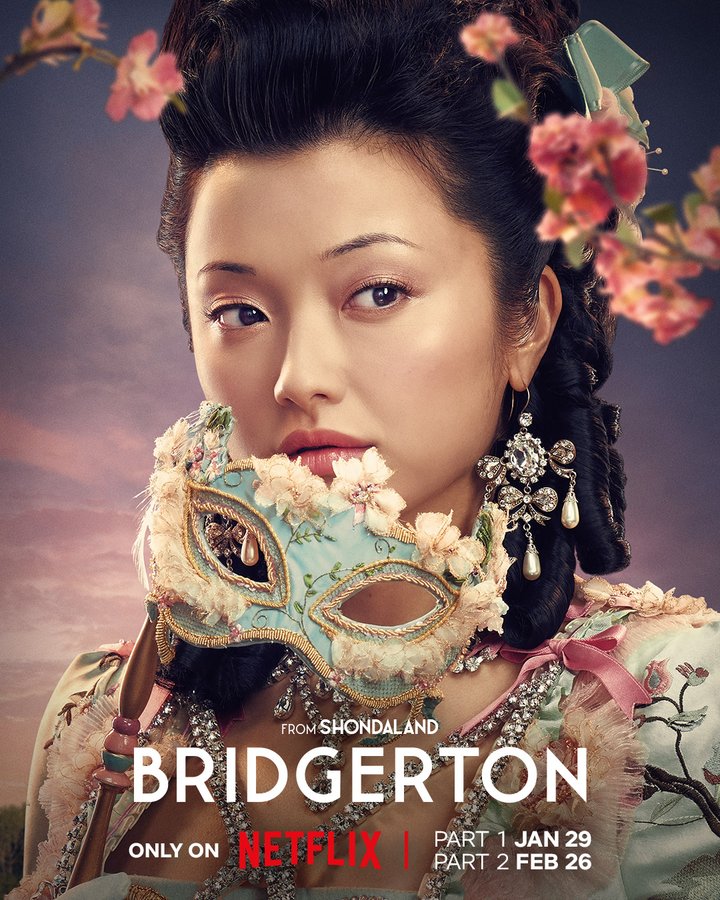
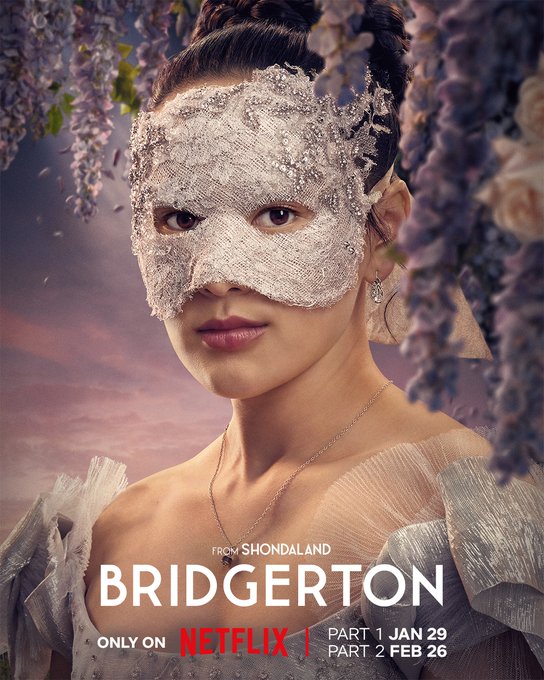
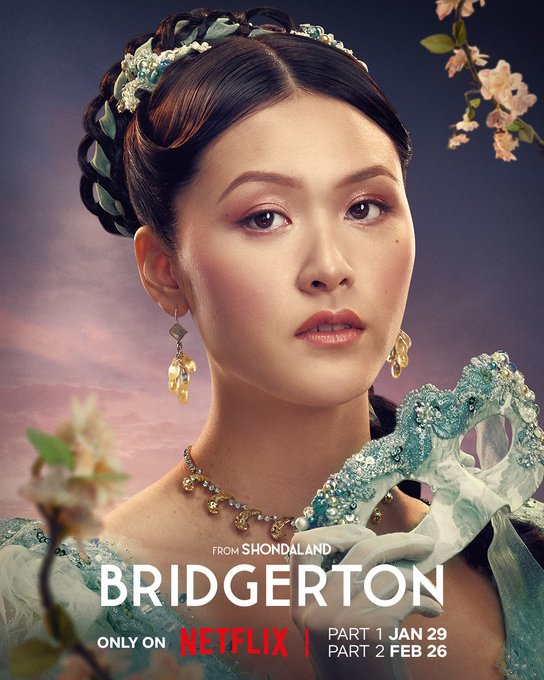
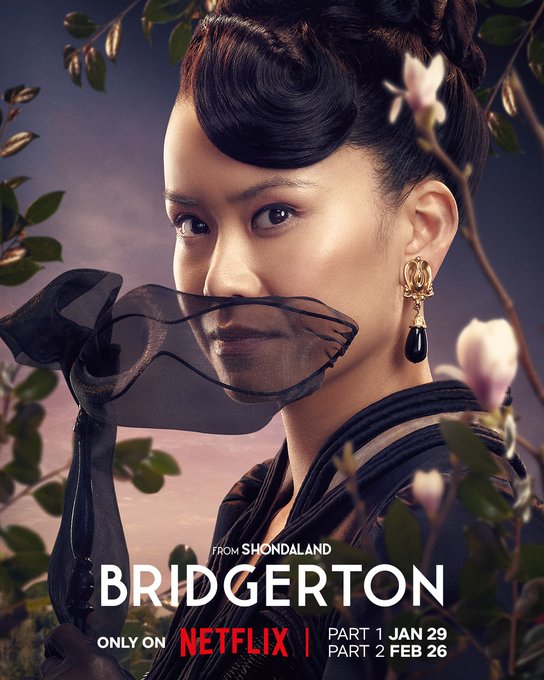
The subtle nods to Asian culture did not stop at costuming, but we’re also referenced even in the promotion pictures. As Netflix Bridgerton’s social media dropped character posters, introducing us to the cast and characters of the upcoming season, each character could be seen posing with a different type of flower in the background. Araminta Gun with magnolias, Posy with cherry blossoms, Rosalind with peonies, and our leading lady Sophie Baek amongst purple wisterias. Each of these flowers have significance and meaning in East Asian cultures. For example, the wisteria in traditional Korean culture is often a symbol of everlasting love, but due to the twisting nature of its vines, can also represent conflict. Wisterias also appear in popular folklore and are known to be a well-known feature of the Beomeosa Temple in Busan.
Some subtle Asian influence can also be spotted in the architecture design and background props within the set for the Penwood estate. Katie Leung reflected back on the color of the walls with Isabella Wei, “Do you remember this kind of jade greenish color that they had? I was so in love with it because it was so subtle.” Moreover, many of doors and walls included a simple leiwen (雷紋) or noemun (뇌문), an angular motif in both Chinese and Korean culture directly translated as “thunder pattern,” often decorating traditional ceramics and architecture. Other props spotted include the black and rosewood furniture such as the armoire with mother of pearl designs and what seems to be Araminta’s shoe cabinet seen in Episode 2.
Language was also subtly inserted into the show, further defining the two East Asian cultures of the Penwood household. Sophie proves to be well read, knowing multiple languages, including Korean. This particular fun fact about Sophie was given some spotlight by Eloise in Episode 4, “An Offer From a Gentleman.” Katie Leung and Michelle Fang were also given a couple lines in Cantonese when Araminta comments on Cressida Cowper’s design choices, “It is rather garish…” in Cantonese, to which Rosamund adds, “It was much more beautiful when we lived here.”
In Season 4 alone, the audience can identify a myriad of Asian influences from multiple countries and cultures, marking a welcomed departure from earlier media portrayals that often lumped Asian cultures into a single interchangeable aesthetic. Between language, costume design, and even promotional photos, the show reveals intention behind even the smallest of details, allowing multiple Asian cultures to interact in the same universe while retaining each of their own unique and separate cultural identities. Though Bridgerton is not an entirely historically accurate period drama, perhaps the incorporation of so many global cultures adds a level of depth and richness only associated with Bridgerton.
For more blends of the traditional with modern in Asian fashion, check out EnVi’s coverage of Asian NYFW.