Author Spotlight: Lesbians, Figure Skating, and Rivals-to-Lovers in Adeline Kon’s “Just Between Us”
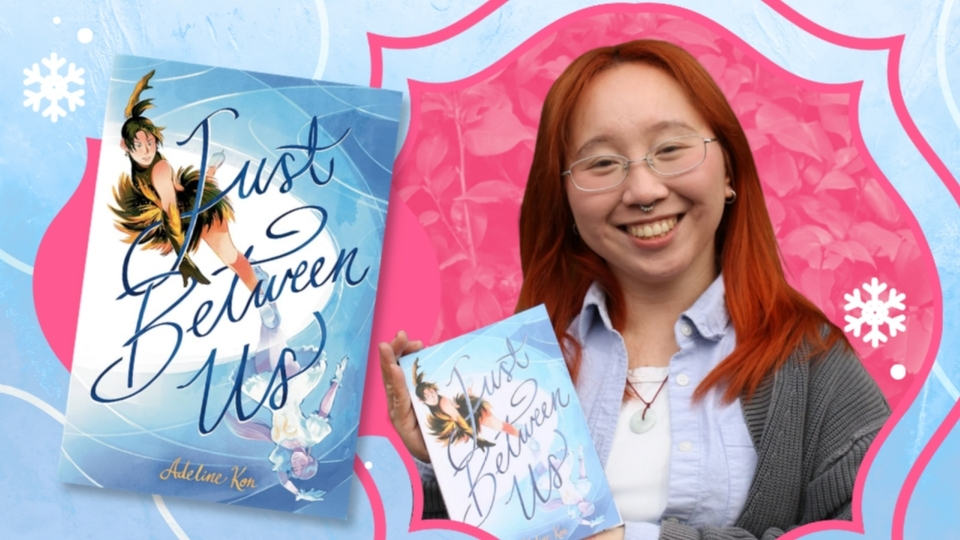
“Figure skating is a game of judgement,” Adeline Kon boldly declares in the opening line of their debut graphic novel, Just Between Us. Dial Books released the eight-year project on February 24, just in time to see the celebration of American figure skater Alysa Liu’s gold medal win at the 2026 Winter Olympics.
Just Between Us follows two skilled young skaters, Lydia Chen and Elaine Yee. Lydia, the “Ice Queen,” is the ultimate technician of her sport, but she finds herself unsure that she loves it. When Elaine begins to train at Lydia’s rink, Lydia can’t help but notice the passion and emotion in Elaine’s routines — something she lacks in hers. As their training forces them into close proximity, tensions flare and both skaters must grapple with what they really want, and what it means to fight for it.
Hailing from Miami, Florida and attending art school at the Rhode Island School of Design, author Adeline Kon is no stranger to comics. Their previous works include the horror comic My Father Was a Good Man and Glimm*r Magazine, a sapphic anthology comic series, in which they worked as its co-creator.
EnVi Media sat down with Kon the morning of their book talk at Powell’s City of Books in Portland, Oregon, to talk about all things figure skating, art, and the addictive rivals-to-lovers dynamic.
Art and Inspiration in Figure Skating
Like millions of others, Kon watched the 2018 Winter Olympics in Pyeongchang, including Japanese figure skater Yuzuru Hanyu’s iconic gold-medal-winning free skate program. But that was only the tip of the iceberg for Kon. Soon after, they fell down the internet rabbit hole of competitive figure skating, going through “forums, Reddit, old YouTube videos, anything.” Two particular figure skaters stood out to Kon: South Korea’s Yuna Kim and Japan’s Mao Asada. They first stumbled upon Mao’s free skate to Rachmaninoff’s “Piano Concerto No. 2” from the 2014 Winter Olympics in Sochi.
“That skate is the reason this book exists,” Kon said. Mao did not win a spot on the podium with that skate, but Kon felt the impact regardless. “I could just tell that this person was almost, like, fighting for their life,” they said. “I was just so moved by the entire thing.” Soon after, Kon discovered Mao’s intense rivalry with Yuna Kim, and subsequently, Kim’s 2010 Winter Olympics free skate program. “She basically built figure skating in Korea from the ground up,” Kon remarked. That year, Yuna Kim broke the world record for the women’s free skate program and won South Korea its first gold medal in figure skating.
The two beautiful free skate programs were magnetic to Kon. The dichotomy of a gold medalist with the weight of the world on her back versus an artist who had yet to place on the Olympic podium but performed “a skate for her and a skate for all fans” drew them in.
The Story Takes Shape
Kon began to develop the story in 2018, aligning with the core elements that Kon needed. “I knew right away that I wanted to write a love story,” they said immediately. “What’s more romantic than having a rival?” As a character-focused writer, Kon took inspiration from Japanese manga, specifically the Yuri genre (Yuri is a genre based on romantic relationships between women). To Kon, Yuri is often a more contemplative genre. In a world where graphic novels explore big themes and stories, Kon opted for something more intimate. While Just Between Us is a sports romance graphic novel, Kon admitted they “just want[ed] to have two girls, you know, thinking and talking about each other.”
Sapphic writing is a cornerstone of Kon’s art and writing. “All of my work is sapphic, even if it’s not inherently romantic,” they said. Their previous work has seen stories where being a lesbian is integral to the character, even if it doesn’t fall in the romance genre.
Just Between Us was destined for romance from the start. Kon began by crafting the two main characters, Lydia and Elaine. Kon fleshed out their characters and made early sketches and concept art while living in Boston for a summer. When drafting of the actual pages began, Kon realized their art was not quite there yet. “I had a lot of good ideas for comic pages and paneling and compositions,” they told EnVi, “but I could not draw well, and unfortunately that did make my actual pages suffer.” Still in art school, they shelved the project a few times and graduated without a pitch for the graphic novel.
Kon never stopped drawing Lydia and Elaine. In 2020, during the COVID-19 pandemic, they returned to the story, fixing up the writing and developing the characters. Still, it “didn’t really have legs,” according to Kon. “No one wanted it.” They were told it was too literary, or too old for Young Adult. In 2021, Kon searched for a new literary agent to help with a different project illustrating for a writer. An agent reached out wanting to represent Kon, and they jumped at the opportunity. After some email exchanges, Kon found that everyone was more interested in their figure skating pitch than anything else.
With help from their agent, Kon took a fine knife to the project and came out with a final pitch for the graphic novel. “My art became to a level of ready, where I’m like, this is going to be a book one day,” Kon said. Although refined, pages from that pitch package ended up as final pages in the published work.
Just Between Us was not an overnight hit. It only began picking up social media attraction in the last four months before publishing, but the reality is much more than that. “This book took me eight years to conceptualize,” Kon said. “To draw, to write, to get rejected, to get rejected again, to redraw, to finally get picked up, to finally be out on shelves right now.”
Black Swan and White Swan, Rivals to Lovers
“Lydia Chen has been Lydia Chen since the moment I started writing,” Kon told EnVi. Lydia began as the concept of a lonely skater who consistently wins and has a difficult relationship with a rival. Elaine Yee wasn’t always Elaine, but Kon knew they wanted a skater from a smaller federation up against Asian American Lydia. They settled on Malaysia due to their father’s Malaysian heritage and pulled the surname from Julian Yee, the first Malaysian figure skater to qualify for the Olympics.
To develop both characters and distinguish their styles, Kon chose two programs from existing skaters that they enjoyed and gave one to each character. When fleshing out Lydia’s character and performance style, Kon referred to 2018 Grand Prix Final champion Rika Kihira’s “A Beautiful Storm” program. “I wanted the feeling of being overwhelmed,” Kon said. “[Lydia is] less artistic but her power is so overwhelming.” Lydia’s jumps are fully illustrated and “bursting of the seams.” Kon wanted a newly debuted senior skater who skates with single-minded focus.
In contrast, Elaine’s figure skating is all about the art. When illustrating Elaine’s program, Kon focused on the finer details such as hand and leg placement. “It’s delicate, in a way,” Kon told EnVi. In the search for a program with the same feeling, Kon landed on Satoko Miyahara’s “Song for the Little Sparrow.”
Kon used “A Beautiful Storm” and “A Song for the Little Sparrow” as a guide for the characters’ personalities and skating styles to represent their differences. The stark difference paints their rivalry as a black swan versus white swan dynamic that goes deeper than their outfits. “I mean, they are literally yin and yang character types,” Kon said. “Like, full black, full white.” Paying homage to the skaters that inspired the novel, Kon added that Yuna Kim’s “Danse Macabre” and Mao Asada’s “Nocturne Op. 9, No. 2” programs also inspired Lydia and Elaine respectively.
The rivals to lovers trope may sound similar to enemies to lovers, but to Kon, there is a fundamental difference. “The thesis statement of rivals to lovers is [that] the other person can take something away from you that you want.” Kon explained. The dynamic isn’t born from trying to overcome their hate, but having to overcome the system they’re both competing in. In Lydia and Elaine’s case, they are both competing for the Olympics, and “for one thing, there is only one gold.”
While drafting, Kon had to dissect their own tastes. “It’s incredibly romantic to hate your rival a little bit, even when you love them,” Kon said, but they weren’t sure if it was going to feel romantic to readers. The key dynamic of their competition boils down to the realization that Lydia and Elaine are important to each other in many ways. “‘I want you in my life. But God damn, this sport is important to me, and I want that medal,’” Kon explained the dynamic. “‘I want it more than anything in the world.’”
The Narrative of Illustration
The relief in writing about figure skating is that the events are already written out. The novel follows the various events of the Grand Prix Season across the country all while counting down to the Olympics. “It was really nice to have this, like, built in structure for a story that was more contemplative outside of the sport,” Kon said. When asked about how they created the narrative structure, Kon shared that they combined the “impactful sports beats” with the strong emotional beats and asked themselves what the most interesting way to explore that moment was.
The medium of illustration can change narrative beats. The emotional moments of the book were particularly impacted by the addition of illustration to the writing. Seeing the strongest moments visually can create more impact on the reader than just words. “It made big emotional romantic moments feel even bigger,” Kon explained. “A big Olympic moment is flying off the page!” But illustration can be a double-edged sword. While the big figure skating moments soar across the page, Kon found that the smaller, more subtle moments needed some work-around. “I can’t leave as much to the readers to interpret,” Kon told EnVi. “I really had to really voice how Lydia was feeling in particular.”
When pitching, Kon made sure their agent knew they wanted to draw comics in greyscale. And for the most part, Just Between Us is. With some exceptions, nearly every page is accompanied with yellow-gold detailing that draws the reader’s eye with a pop of color. The detailing highlights crucial internal dialogue, backgrounds, and sound effects that bring the action off the page.
When asked about their favorite pages or spreads from the book, Kon doesn’t hesitate to share two: one for each character. The spread on pages 290 and 291 illustrates Elaine’s skating program, complete with the delicate details of Elaine’s gloves and poised hands. A friend of Kon’s shared that she believed these pages “feel like I’m looking at Elaine the way Lydia is falling in love with her.” Kon’s other personal favorite was originally drawn for the pitch package, and helped them discover how they were going to depict figure skating. Page 97 illustrates Elaine skating metaphorical circles around Lydia’s head while she admits, “I just like to watch her skate.”
On Marketing and Representation
The common tagline of Just Between Us being “the real Yuri on Ice” references the popular figure skating anime Yuri!!! On Ice. Notably, the anime focuses on the relationship between two male characters, despite having “Yuri” in the title. “People like a clever quip,” Kon said when asked about the marketing of the graphic novel. “Think about how many Yuri!!! on Ice jokes people have been making since it came out in 2016.” When working on Just Between Us, Kon needed comparative titles to be able to sell the story, but the only things Kon could compare it to at the time were Spinning, Check, Please!, and Yuri!!! On Ice. All titles are queer and take place on ice, but none of their stories were apt comparisons.
A more recent comparison is the hit hockey romance sensation Heated Rivalry. Kon noted that despite the difference in explicit content and sport, Heated Rivalry is a better comparative title for Just Between Us than any listed above. “It’s about two rivals who have an unexpected magnetism to each other,” Kon explained. “[They] have a secret relationship of sorts, and are standing on top of the world stage as the most competitive of their sport.”
While media about lesbians and media about gay men are both queer, their audiences don’t always overlap. “To be honest, I wish that there was a sapphic thing that was so popular that I could compare it to,” Kon admitted, “But it’s just like, those things aren’t known in the mainstream.”
Luckily, the combination of Heated Rivalry and the 2026 Winter Olympics created the perfect pop-culture zeitgeist for Kon to drop Just Between Us. For now, Kon is just glad to have eyes on their book, “I think it’s brought greater joy to me and to people who have been searching for a book like this than it is negative.” They hope that more sapphic media continues to lead to more sapphic stories being told. “Fingers crossed, maybe [Just Between Us] could be the popular sapphic thing,” they said, “that then when other people make rivals to lovers stuff, they can use my book.”
Representation is not the only important element of the graphic novel. Lydia’s identity as a Chinese American woman and Elaine’s as a Malaysian woman inform the story, even if it isn’t blatantly stated. In fact, Kon didn’t go into Just Between Us planning to represent Malaysia. They wanted to represent smaller skating federations competing in the midst of skaters from the USA, Russia, and Japan. The character Elaine “sort of represents the hopes and dreams that even smaller countries can find their path to success in this really beautiful sport,” Kon said. However, when promoting the book Kon began to receive feedback from readers who were ecstatic to see Malaysian and Southeast Asian representation in a sapphic character.
“It means a lot,” Kon said of the reader response. Figure skating fans don’t often get to see this kind of representation in real life. To Kon, people often want figure skating to advance faster than it actually is. Queer fans dream of same-sex ice dance pairs. Fans of smaller skating federations dream of winning the gold. “It’s still a pretty homophobic sport,” Kon admitted. “[And] athletes from smaller countries don’t have as many resources.”
The figure skating world makes small steps forward as time passes. At the 2026 Winter Olympics, American figure skater Amber Glenn made history as the first publicly out queer Olympic women’s figure skater. At the same time, Mikhail Shaidorov of Kazakhstan won the country’s first-ever gold medal in figure skating, following the path trailblazed by the late Denis Ten. “I love skating for all the things that make it beautiful, and I accept the parts that bring a lot of pain,” Kon told EnVi. “So I wanted to really depict [the] things that were real and painful and special to me.”
Love and Art in Fandom
At its core, Just Between Us is Adeline Kon’s love letter to figure skating. During the pitching process, Kon asked themselves this question: “Is it important to depict figure skating as accurately as possible, or the way I feel about it?” Kon already had a decent knowledge bank of figure skating from the internet research rabbit holes they fell down after the 2018 Winter Olympics. From that, they settled on a rule between “not [being] too concerned with being completely accurate” and “never having it be completely reality breaking.” Kon portrayed their love of figure skating from the heart of a fan and an artist.
Kon is no stranger to fandom. “I grew up on fandom,” they said. “[I] spent my childhood sitting around and thinking about Naruto characters.” For Just Between Us to receive fanart and responses from readers amazed Kon. Although the fan art that most have seen came from Kon’s friends, “some of it is from strangers, and that is crazy to me.” The idea that readers would be thinking about Lydia and Elaine “even in their own day, in their own life” is a high honor to Kon.
Although Just Between Us is about figure skating, it boils down to Kon’s relationship with art. Between art school and the eight years it took to develop the graphic novel, Kon had to confront their feelings about art much the same as Lydia had to confront hers about figure skating. “I think over time, it became a story that was more of a reflection of my own personal experiences with art,” Kon said, “especially post art school blues.” They grappled with their passion and hobby becoming work and how to stay inspired.
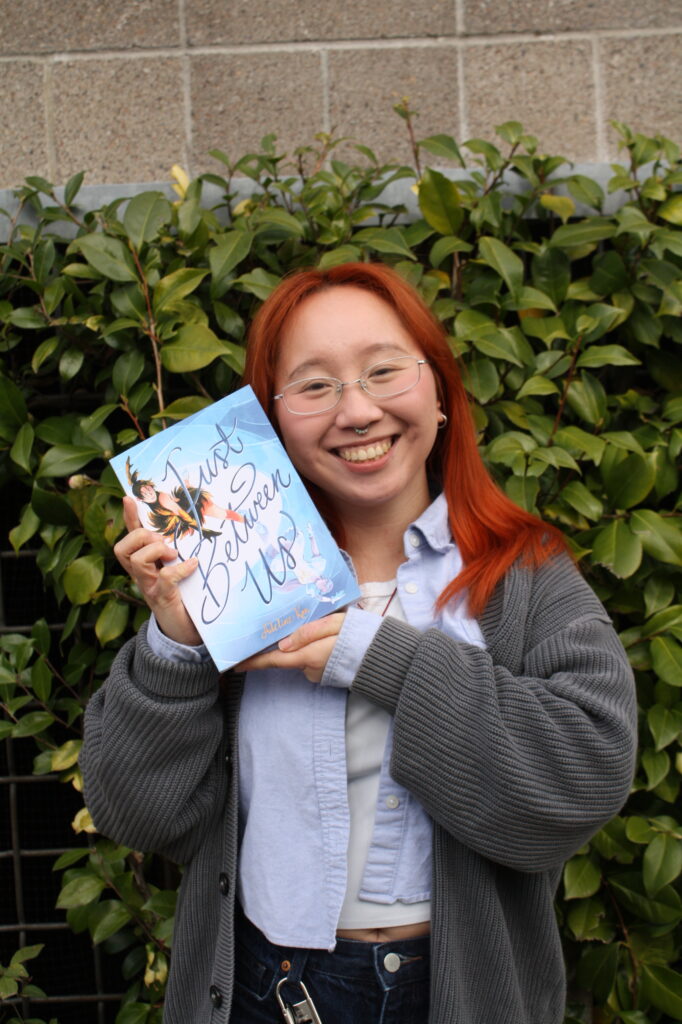
“The art you make is important because it’s yours,” Kon said later that day at a book talk at Powell’s City of Books. They will move forward using all the lessons they learned from creating their debut graphic novel. Two and a half years of drawing, a year and a half of writing, and 322 pages later, Kon confidently declares they wouldn’t be the artist they are today without Just Between Us.
Just Between Us is available in most bookstores or online through Penguin Teen. Keep up with Adeline Kon on Instagram, X, and TikTok, or visit their website to see more of their works!
Want to read about the latest from your favorite authors? Check out EnVi’s coverage of Chloe Gong’s Coldwire.