The American Dream Seen “Slanted”
Amy Wang’s directorial debut Slanted (2026) hit theaters earlier this month, bringing a story centered around internalized racism, Western beauty standards, American nationalism, and teenage social struggles to the big screen. Warning: spoilers to come as we dive into this film!
Slanted follows Joan Huang (Shirley Chen) as she struggles to fit into her predominantly white town. Having experienced racial discrimination from a young age, she’s desperate for acceptance and to achieve one of her dreams: becoming prom queen. In order to do so, Joan makes the perilous decision to undergo cosmetic surgery to erase her Asian features and become white, transforming into her counter persona Jo Hunt (Mckenna Grace).
The film is a daring concoction of genres, encompassing racial satire, absurdism, body horror, coming of age, family drama, and chick flick. It’s a movie that’s meant to keep its audience swinging between bouts of laughing, crying, and fright. The most polarizing point of the film is when Joan transforms into Jo, with the unique choice to switch actresses to portray this drastic change.
Director Amy Wang was more than aware of the controversy that would arise from Slanted. In fact, it was her intent on sparking conversation and divisive reactions. “I like pushing buttons. I love making people squirm and be uncomfortable and ask questions. I knew it would be controversial, but I knew I wanted two different actors,” said Wang in the film’s press notes.
The ambitious combination of genres and the literal manifestation of Joan’s insecurities may seem over the top. Issues of identity and assimilation are purposely hyperbolized in this way, perhaps to counter the way they are usually perceived in Asian-American childhoods and realities.
The Dream of Prom Queen
The film opens with a younger Joan (Kristen Cui) being driven to her new school. We watch as Joan looks at passing billboards and storefronts plastered with Americana imagery, as well as slim, white faces and bodies. This foreboding visual is accompanied with the warm vocals of Teresa Teng’s “The Moon Represents My Heart” blending with Joan and her father Roger’s (Fang Du) voices as they sing along.
After a disastrous first day at school where she faces ridicule and feels ostracized from her classmates, Joan and her mother Sofia (Vivian Wu) go to pick up Roger from his job as a janitor at a high school. When the adults aren’t paying attention, Joan is drawn to echoing music and laughter in the gymnasium. Like stepping through the wardrobe into Narnia, she’s swept into a world of disco lights, sparkling streamers, and glittering dresses. “Prom queen represents American values and who we all strive to be,” a teacher announces as Joan witnesses the most popular girl crowned the title.
From then on, Joan has a newfound dream.
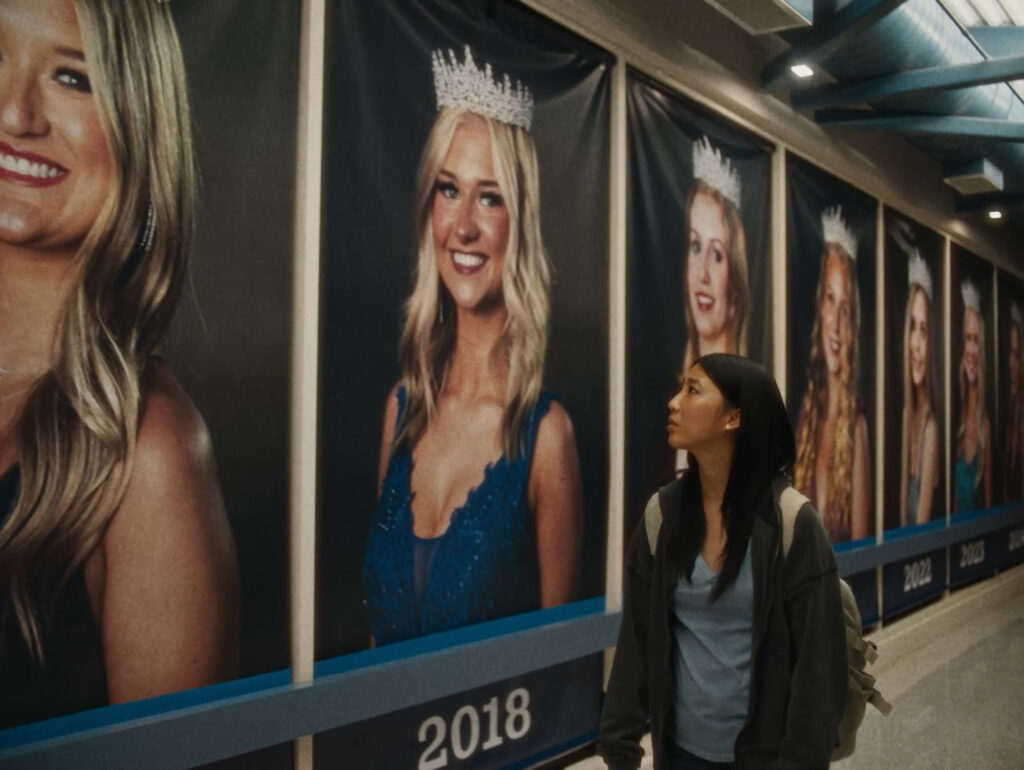
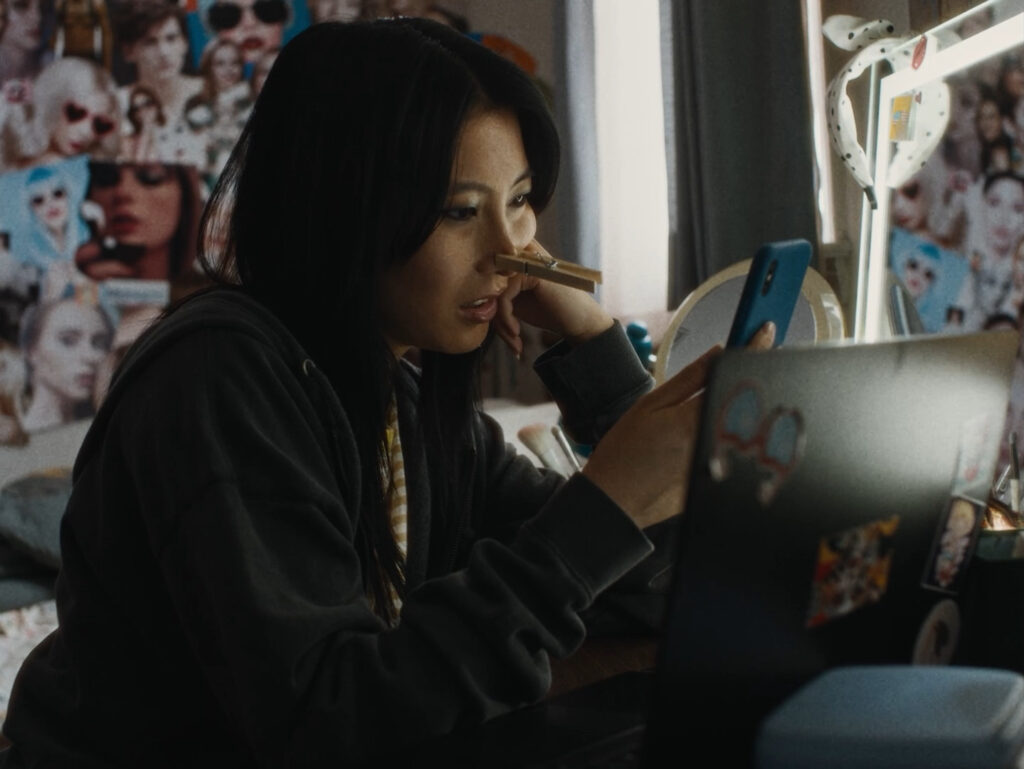
Now in high school, Joan is more insecure than ever of her appearance. She indulges in filters that give her blonde hair, blue eyes, and a high nose. In a striking scene reminiscent of The Substance, Joan walks down a hallway of framed past prom royalty, an eerie and twinkling melody resonating in the background as she stares at the large portraits towering over her.
In her idealizations, she looks longingly towards Olivia Hammond (Amelie Zilber), the school queen bee who always has a flock of admirers on her tail. Despite her best friend Brindha (Maitreyi Ramakrishnan) asserting that she doesn’t need to be occupied with Olivia or the prom queen title, Joan sees an opportunity for a change when Olivia proclaims that she will not be running for prom queen this year; instead, she will be offering her endorsement to a lucky girl.
So begins Joan’s pursuit of prom queen… and the beginning of her cursed transformation.
Dressing the Part
The costuming in Slanted strays away from the caricature of Gen Z teenagers often seen on mainstream media. Instead, the outfits accurately represent the generation’s style. At a screening by AZN Americana, costume designer Michelle J. Li explained the intentional choices behind the clothing in order to portray each character and their arcs. Brindha arguably dresses the most differently from everyone else, donning baggy streetwear and statement jewelry pieces. The alternative edge to her outfits communicates her confidence in her identity and how she feels “more authentic to herself.”
Olivia was the only character who wore real designer clothing. Her actress, Amelie Zilber, sourced “personal, true vintage passed down to her from her mom [and] her grandma.” Every other character wore typical retail clothing — and the visual difference is palpable.
As Joan tries to get close with Olivia, she begins changing her appearance in an effort to gain popularity and favor. She bleaches her hair, leaving it brittle, and her wardrobe becomes increasingly Brandy Melville-esque. Yet her efforts are glaringly forged, and made even more obvious when standing next to Olivia, who does not hesitate to let her know just that.
Joan is elated when Olivia invites her to get their nails done. Her joy deflates when she realizes that she was only invited to ask for the “local discount.” It’s an intriguing scene that depicts the complex power dynamics between Joan, Olivia, and the nail salon owner. In the larger landscape, Olivia undeniably holds more power, but within the nail salon, the owner holds the reins. When she tells Joan that only she is eligible for the discount and not the others, she offers community and inclusion through the means of gatekeeping.
But, as expected, Joan takes the offered branch only to extend it to Olivia. After getting a fresh mani-pedi, Olivia doesn’t hide her disdain, and tells Joan that she can see her roots. Indeed, her black roots are peeking out, bleeding into her pristine blonde hair.
At the end of her rope, Joan is lured into ethnic modification surgery by Ethnos, a sketchy, holistic-marketed clinic headed by Dr. Willie Singer (R. Keith Harris), a previously Indian-American doctor who grew weary of being overlooked in his workplace. As a result, Singer developed a groundbreaking procedure to become white. “If you can’t beat them, join them,” Dr. Singer says, believing that this is the only viable path to equality.

Assimilation hinges on the question of who is included and who is excluded. Dr. Singer’s ideal of assimilation and joining the power of white American society revels in the participation of exclusion. On the other hand, both the nail salon owner and the Chinese community have created a place of inclusivity as a product of being excluded from white American society.
Lisa Wong Macabasco, Vogue writer and editor, spoke to the Asian American experience and the American dream at the AZN Americana screening: “She [Joan] doesn’t want to be white because she thinks that’s good — she wants to be accepted and she wants to succeed. And I think that a lot of people can relate to that ‘wanting to succeed’ and that maybe if she were different, she could succeed.”
A Dream Realized and Unraveled
Joan’s transformation into Jo is marked by song.
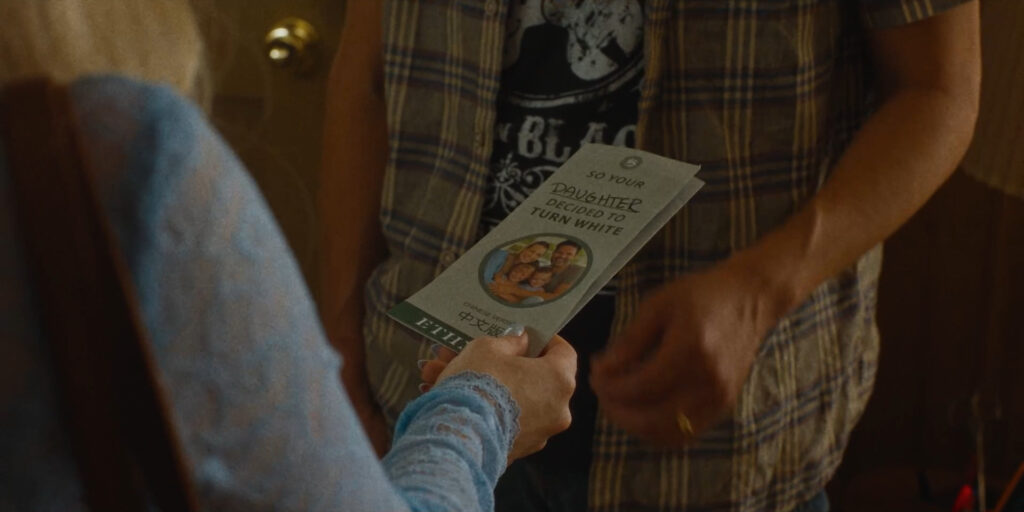
“It’s good to be white,” a generic infomercial pop number sings over a montage of white people doing stereotypically “white” activities. With that, Jo awakens to a head of blonde hair, blue eyes, pale skin, and a brochure in hand for her parents.
Her parents don’t recognize her, or perhaps refuse to accept the reality of their daughter’s transformation. It’s only when Jo sings Teresa Teng’s song, their beloved family anthem, that they look at their daughter’s new face. This scene has been garnering polarizing reactions, but that is similar to how Jo’s parents feel. The moment is comical and ridiculous. What is this white girl doing in their home? It is heartbreaking and volatile. Jo is now a stranger in her own house.
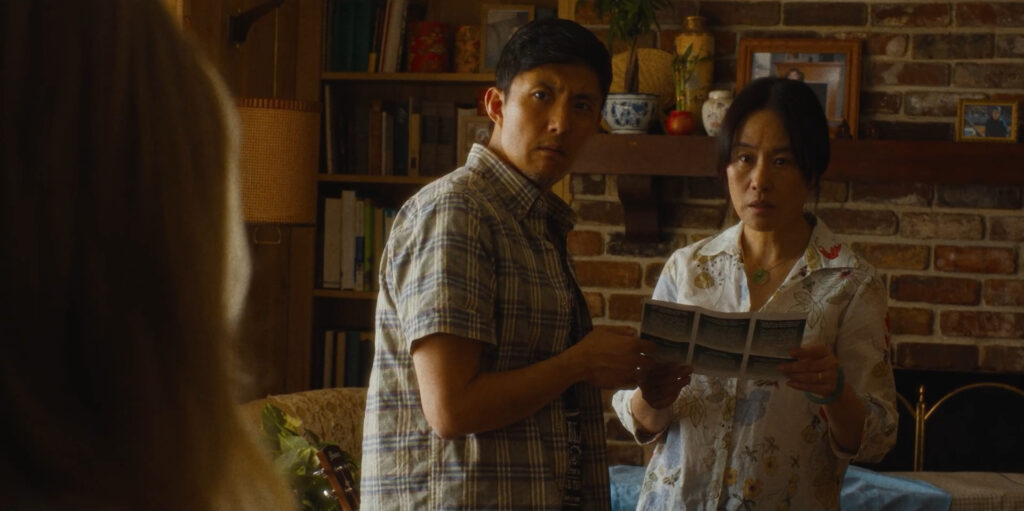
Jo gets everything she wanted. She quickly joins Olivia’s ranks, sitting together during lunch, where the whole table whips out their tupperware salads in ritualistic performance. In a defining shot, the American flag hangs behind the group in the cafeteria, triumphant and looming. Jo finally earns Olivia’s endorsement for prom queen, but not without the sacrifice of her friendship with Brindha. Jo is hit with a troubling question from Brindha: how much her own self-hatred extends outwards?

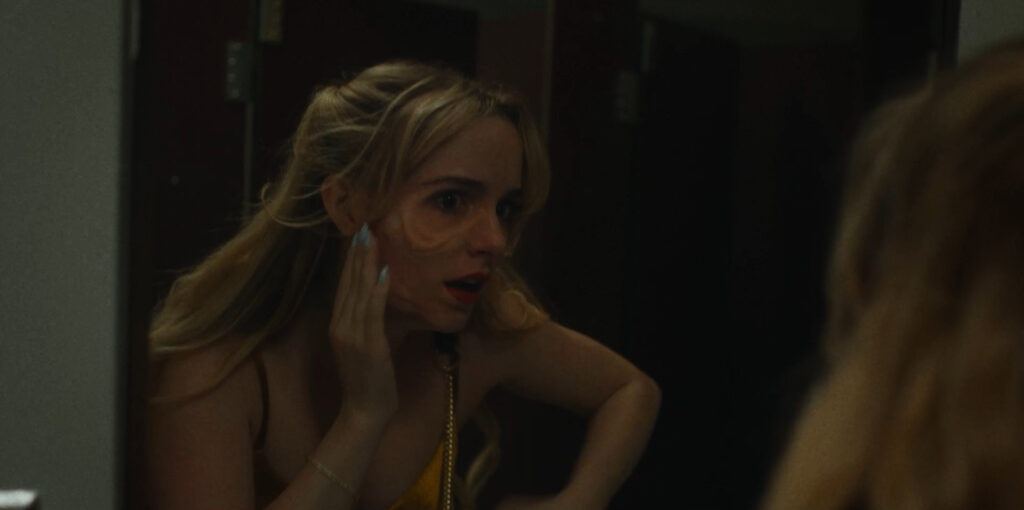
But it is all worth it. Jo is on the precipice of being crowned prom queen — if not for the fact that her skin seems to be melting off her face. In a shocking twist, Olivia walks in on her in the school bathroom. However, her reaction is unexpected. She gingerly brushes Joan’s hair aside, soothes her sagging skin with cream and tape, and assures her that her original face will fight back at first. It’s a poignant, tender, and warped moment of understanding between the two girls.
As Jo stands on the stage before her classmates under the blinding spotlight, a sparkling crown on her head and a sash draped around her, her dream quickly morphs into a nightmare. Her classmates scream in terror and she realizes that her face is deformed again.
Jo passes out. When she comes to, she’s in Olivia’s house. She joins their dinner, picking at a plate of boiled chicken and rice as she learns that Olivia and her father used to be Cuban-American and haven’t spoken to Olivia’s mother since she refused to get the surgery.
“She could’ve had all of this,” Olivia’s father remarks, gesturing at the barren, white space that looks like the cover of a furniture catalogue.
To Jo, Olivia embodied the persona of prom queen. She was what Jo strived to be. Now that Jo was faced with her future, however, she realized that with all that she would gain, she would also lose everything that she held dear — most of all, her family.
Becoming Her Own American
Slanted depicted a refreshing portrayal of the loving relationship between Asian immigrants and their children. Roger and Sofia do not shy away from showing affection and affirming words to Joan/Jo despite her transformation. The married couple also display deep affection towards each other every time they share the screen, demonstrating that they are each other’s anchor in this tumultuous environment. Wang was inspired by her own parents and wanted to beat the “gruff Asian dad” stereotype with the casting and development of Roger’s character.
The depiction of the flipped power dynamics between immigrant parents and their children was a focal point in Slanted. This is shown when Sofia sends Joan to speak with Roger’s employer while she chooses to sit in her car and wait. When Joan acts as translator between her father and his employer, she purposely leaves things out, altering the meaning of their sentences to each other.
The most defining display of the power Joan holds over her parents is when she tricks them into signing the consent forms for her surgery, claiming it’s a permission slip for a school field trip. Throughout the film, Joan uses this capability to get her way — but later, in a vulnerable moment, she collapses in her mother’s arms, in tears and at a loss of what she’s done, reminding viewers she is but a child.
Her parents relate to having tried to assimilate and aspire towards the white American ideal themselves. “I become my own American,” Roger tells her, urging her to form her own identity rather than become something she is not.
When Joan and her mother return to the clinic and plead to Dr. Singer to reverse the surgery, he tells them that the procedure is permanent. In order for the side effects to fade, Joan must completely reject her Asian identity. “In order for the plant to flourish, the seed has to die.”
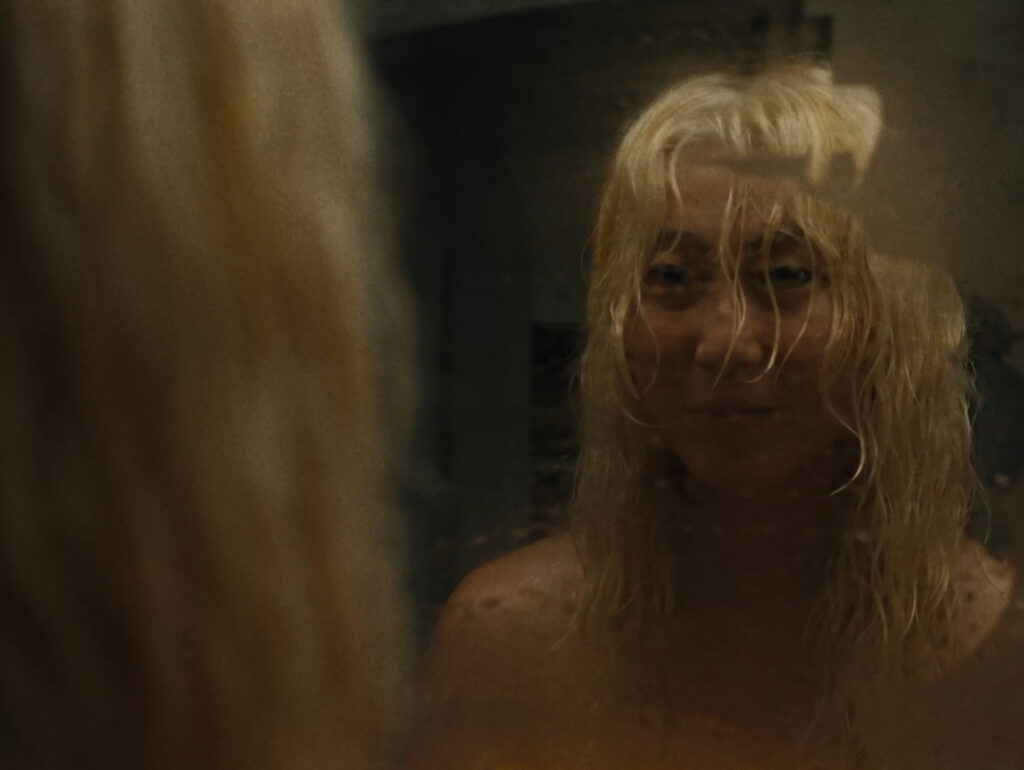
Desperate and anguished, Joan ferociously tears at her face, clawing and ripping away her skin. As she peels back her bloody skin to reveal her original monolid eyes, she stares at her reflection and smiles tearfully, embracing a newfound vision of herself.
Wang reflects on the ambiguity of the ending and believes that it isn’t a happy one. But there is a sense of “joy [that] comes from Joan finally seeing her Chinese self and smiling, whether or not she ever returns to looking Asian, because she finally recognizes: this is me, and I’m proud.”
The old Joan has died, and what has been done cannot be erased. But perhaps now there is a chance to flourish and the chance to “become.”
Want to get into more horror films? Check out our exclusive interview with Olivia Cheng on her role in Ready or Not 2!