Author Spotlight: This is How Yulin Kuang Ends a Love Story
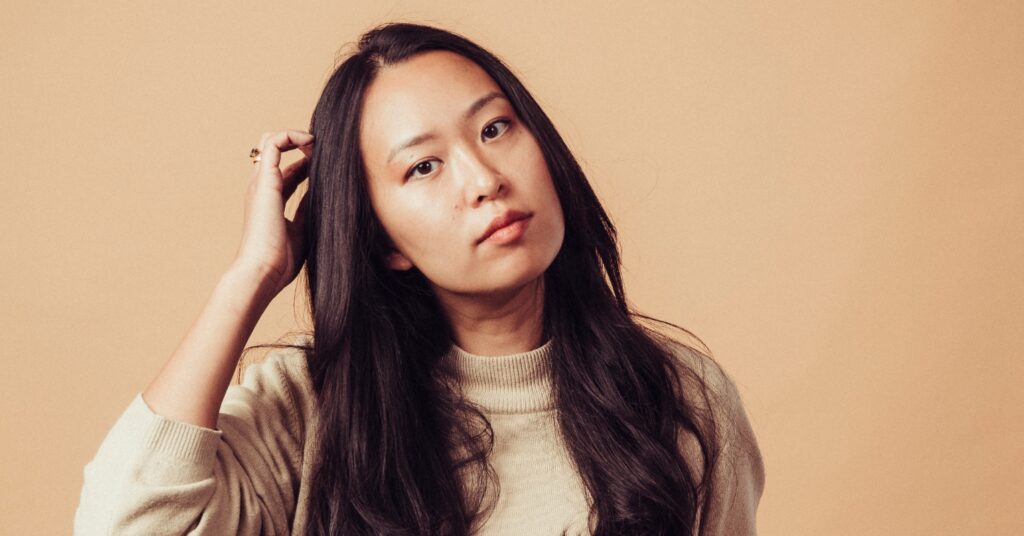
The night How to End a Love Story came out, Yulin Kuang hosted a self-directed, one-scene adaptation of her novel at Vroman’s Bookstore, which set the perfect scene to introduce the multi-hyphenate artist.
Many might recognize Kuang as the slated screenwriter for Emily Henry’s acclaimed Beach Read and People We Meet on Vacation as well as director of the former. Long time followers will know her from her To All the Boys I Loved Before adaptation trailer which she made as part of her literary adaptation series on her YouTube channel. Kuang is a director, screenwriter, and now author of How to End a Love Story.
When asked what led her to the decision to adapt one scene from her novel, Kuang laughed. “I think it was the same thought process that led to me doing a choreographed dance for my first dance at my wedding,” she said. “I knew it was going to feel like a high stakes kind of evening, and so I was seeking comfort in the familiar, which is performance anxiety. […] By putting on a little one scene adaptation, I would be more in a director’s headspace than a debut novelist’s headspace.”
How to End a Love Story follows bestselling author Helen Zhang and screenwriter Grant Shepard who are bound by the tragic death of Helen’s sister in high school. Thirteen years later, the two artists meet again in the writer’s room for the TV adaptation of Helen’s young adult series. If they want to leave this complex situation unscathed, Helen and Grant must come face-to-face with their past, and each other. The novel was Reese’s Book Club Pick for May and was one of Marie Claire’s best romance books of 2024 so far.
EnVi caught up with Yulin Kuang after her book tour across North America to talk about her debut novel, creative process, and how she would end a love story.
Fandom and Adaptation
“I have always been drawn to storytelling,” Kuang told EnVi. She sat in front of a bookshelf which she dubbed her “romance shelf” and recounted the moment she knew she wanted to be a writer. While she discovered fanfiction early on in her life, it wouldn’t be until she was 15 when she made a deal with herself. If one of her fanfictions landed on the Top 10 end-of-year round-up on LiveJournal, she’d pursue a career as a writer.
“And I did,” she said proudly. “[Fanfiction] altered my brain chemistry and changed the trajectory of my life.”
She went on to study creative writing and film at Carnegie Mellon University, where she’d hand off her screenplays for other people to direct. “And then they kept fucking it up!” she laughed. “So, I [decided that] I’m going to do it. Then I really fell in love with [directing].”
Kuang described fandom as her “through the looking glass moment.” She understands what it’s like to be a reader and a fan. Growing up, she’d see adaptation news for her favorite books and she recalled feeling anxious. One of the questions she asked herself was, “How do I make sure that my favorite books get adapted properly?”
“I think that informed my trajectory in a huge way,” Kuang said on the role of fandom in her childhood. “I dreamed and schemed my way to get exactly here. For that reason, it’s a very long held dream to be on this side of the looking glass.”
Exploring the Familiar
In How to End a Love Story, Grant and Helen attended the same high school but orbited in different social circles. Grant was on the high school football team as well as homecoming king, while Helen was the editor-in-chief of the school newspaper. What drew Kuang into the characters’ high school archetypes was familiarity. “One of my all time favorite romance novelists, Sarah McLean, has this rule where romance heroes have to be kings of some kind,” Kuang explained. “Then [Grant] is homecoming king, [and] for Helen, I gave her the overachiever archetype because that was what was familiar.”
As an avid Tumblr user growing up, Kuang recalled reading discourse on representation, and which representation was good. “[There was] the idea that maybe we need more slacker Asians. [Maybe] we need more stoner Asians,” she began. “I was trying to write those characters into movies and TV shows that didn’t get made. And when I decided to write [my] book, I [asked], what feels more truthful?”
She went on to explain that “I was kind of an overachieving Asian, and that was the click. Then it became a question of what that actually looks like. We have seen the stereotype of [overachieving Asians] but there is some truth to what that personality type is and I wanted to examine how we get that way.” Helen Zhang became a deeper exploration into generational trauma and how that manifests in our day-to-day life and our very identities.
As for the inception of the tragic past that bound Grant and Helen, it came “very late in the development of this concept.” While writing How to End a Love Story, Kuang was also working on the adaptations of Emily Henry’s Beach Read and People We Meet on Vacation where she “resonated” with Henry’s words and the shared hurt her characters experienced. This reflected Kuang’s interest in “examining a shared wound between a screenwriter and a novelist.” However, she later clarifies that it was “the specificity of suicide [that] unites [Grant and Helen].”
“It makes a lot more sense to me in retrospect, looking at what I was going through at the time,” Kuang began tentatively. “I’ve known a lot of people who’ve gone through serious mental health struggles, and I have, too. So I wanted to examine what happened to the people who were left behind in the aftermath of that kind of worst case scenario.”
Screenwriting versus Novel Writing
For Kuang, exploring the deep cuts of being alive is just as important as the development of romance, if not more. To ensure she hits all the necessary beats and carve enough space to explore the themes of her novel, she attempted to outline How to End a Love Story the same way she would for scripts.
Kuang is meticulous when it comes to planning her scripts. “I cover exactly what’s happening in every single scene,” she explained. “I cover dialogue beats and sometimes, I even include the dialogue [itself] so when I get to the drafting stage, there’s almost no room for surprise and I can power through.” She described her outlining process as “architectural.”
So when she initially approached How to End a Love Story, she “created this story structure and I was going to write into it.” But Kuang discovered that “writing a book feels more like gardening than architecture.” She went on to explain that for novel writing, “I was planting all of these seeds and watering them. Then […] new things would bloom that I didn’t expect.”
Kuang wrote her debut novel during National Novel Writing Month in November 2021 while also working on the adaptation for Emily Henry’s People We Meet on Vacation. When asked how she balanced such big projects, Kuang laughed. “I had no work-life balance at that point in time.”
She outlined her writing schedule which she had planned to the tee. “I would wake up at 5 a.m. and write [How to End a Love Story] until 10 a.m. Then I would switch over to People We Meet on Vacation and write until 5 p.m.” Kuang would go on to continue working on her novel late into the night. She’d wake up the next day and repeat the exact schedule.
“Except on Saturdays and Sundays,” she clarified. “[That’s] when I would catch up on my sleep deficit.”
Kuang completed How to End a Love Story in one month, “and I have not been able to replicate that at all,” she said with a sigh.
On Hobbies as a Creative
In the midst of her creative career, figure skating became a rewarding outlet for Kuang.
She recalled being “obsessed” with the Winter Olympics, specifically Michelle Kwan and Tara Lipinski who were going for gold in Nagano, Japan. “I begged my parents for figure skating lessons but […] that [wasn’t] in the financial cards for us. So, I sat with that for years but I was always obsessed with the Olympics.”
In 2018, Kuang had her own “disposable income for the first time in my life.” She remembered watching the Olympics and also reading a Sarah McLean novel that involved ice skating in the Victorian Age. “If these people who are Victorians know how to ice skate, surely I can also figure out a way to ice skate,” Kuang exclaimed, so she finally decided to take matters into her own hands. She scoured the Internet then found herself an ice rink and a coach.
“I really fell in love with [figure skating] because it was a way to be mediocre at something and also watch myself get better,” she said. “I also think at that point in time, I didn’t have any hobbies. Everything I did looped back to my work.”
She explained that she would read romance novels, watch reality dating shows, and attend improv shows, but all those activities went back to research for the romance genre. “Whereas figure skating, it was [something] I was so bad at that I just knew I’m not going to make money doing this,” she said with a laugh.
Romance as a Hopeful Narrative
Kuang recalled Anne of Green Gables being one of the books that cemented her love for the romance genre. “I remember discovering the entire text of that on Project Gutenberg because it was in the public domain, and I just sped through that,” she said. “And I think Gilbert Blythe was some sort of foundational text of what I thought romance should be.” She paused then added “[which] in retrospect, is not necessarily the best thing.”
Kuang explained that Gilbert Blythe falls into the harmful idea that if boys are mean to a girl, that must mean they like them. “But I think Gilbert goes on a journey, and so does Anne over the course of the next several books,” she said. “And so I really loved their love story.”
When asked if she thinks characters need to end up together in a romance, she believed “that’s part of the definition of the genre. They have to end up together, otherwise it’s not considered a romance in publishing.” She went on to add, “I think there are plenty of love stories that don’t end happily. [They] are good stories but they’re not stories that speak or resonate with me as much. […] I am drawn more towards hopeful narratives.”
For Kuang, a good romance ending requires the right amount of angst. “I need a moment of suffering. Then I need [groveling] and [a moment where] all is lost. And then I need a really good kiss.” Her excitement and pure love for the genre were unmistakable through the screen. “In figure skating, they have a grade of execution on all their different elements. Those are the different elements I am judging by when I am going into a romance,” she said.
Kuang left the interview with one wish for readers.
“Read more romance,” she said. “Read more romance you don’t think you would enjoy.” Kuang went on to explain, “Because of the way that we are fed things algorithmically, it feels like there are these really big blockbuster titles that everybody is aware of. Sometimes, people will look at those [titles] and then they won’t go any further. […] I wish people would be a little bit more adventurous when trying their romance tastes out.”
“The romance genre has so much to offer [to] readers.”
How to End a Love Story is available for purchase at your nearest bookstores and online retailers. You can follow Yulin Kuang on Instagram and subscribe to her Substack for more updates on her upcoming projects.
Interested in reading more author interviews? Check out EnVi’s interview with author Peng Shepherd here!