Author Spotlight: How Chloe Gong Built the World of “Coldwire”
When two nations are locked in a cold war, what happens to those who are considered the “enemy?”
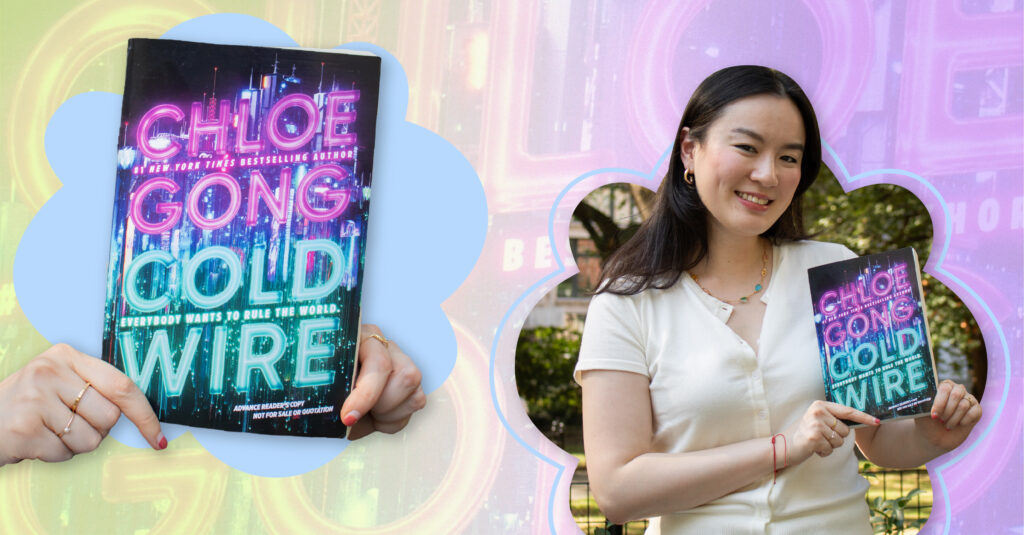
Chloe Gong set out on a thought experiment to figure out (some) answers in her newest novel, Coldwire. The cyberpunk novel follows four main characters — Lia Sullivan, Eirale Ward, Kieren Murray, and Nik Grant — and alternates between the perspectives of the leading ladies. They exist in a world where living in the virtual world (Upcountry) is more entertaining and more comfortable than their reality ravaged by climate change (Downcountry). Two nations locked in a cold war (Medaluo and Atahua), a powerful billionaire company, and a dominant military form the foundation of these worlds.
“I think this is a thought experiment that’s going to become really relevant to us as we go forward in our technological society,” she told EnVi a few months before the novel’s release. Artificial intelligence, giant corporations who just about rule the world, military complexes, adoption industries, and the possibilities of virtual reality all find a home in the 500-page young adult novel.
Yet among these topics that make our world’s headlines, Gong also uses Coldwire to explore the complexity of relationships in the face of technology. The author further excavates what happens when identities given to you by governments and other nations dramatically clash.
“I didn’t want it to be a classic tale of one government versus the people,” the bestselling author shared. “I wanted [Coldwire] to [explore] what happens when we are in the shadows of a bilateral disagreement between two countries.”
In our fourth conversation together, Chloe Gong and I discussed returning to the young adult space and thinking through big-picture questions — like how to be yourself when technology both takes over your world and becomes your world.
Writing a Story for Young Adults
“I knew Coldwire had to be young adult,” Gong firmly stated. Young adult dystopian novels are a space for teens to have “something they can use as a comparison point,” the author also mused. “Otherwise [young adults] might not be able to express these ideas that they’re definitely thinking about.”
Take the struggle to make sense of heightened global tensions. Gong noted, “We [Gen Z and Millenials] have been in the shadow of global relations” throughout our lives. The author has a particular interest in international relations, which she nurtured while in college. In 2020, Gong graduated from the University of Pennsylvania with a degree in English and international relations.
The groundwork for Coldwire came together during this time. Although the story was always going to be cyberpunk — and center the “little guys who are working [against] the giant” — it took years for the finer details to fall into place.
Gong became interested in cyberpunk because of a TV show she watched while she was younger. However, the author dug even deeper into the genre in college classes revolving around techno-orientalism. (Since a writer is always going to write, she shared some of her research about techno-orientalism on her blog back in 2019.) These courses broke down how cyberpunk is usually portrayed as futuristic cities often drawing from modern Asian city aesthetics and relearning how to think critically about this portrayal.
The Roots of Coldwire
Gong revealed the idea that would eventually become Coldwire on the first date with her now-boyfriend. As he was someone who was studying computer science in school at the time, she had many questions for him. “What is going on in this space, and where do you think this is going?” Gong had asked him.
Their discussions supplemented her own thoughts about technology, virtual reality, and AI. “I was working on my own thinking about, well, what do I want to explore about the way I think our technology is heading into the future and what is something like that going to look like,” she told EnVi, gesturing a bit with her hands for emphasis.

Now, remember, this was all happening around the good year of 2022 — before we began seeing every other headline being about AI and the metaverse. So, yes, Gong sort of predicted the future, but when the beginning signs start to emerge, then that’s the perfect time to also begin considering novel thought experiments.
Besides these technological aspects, Gong wanted to explore virtual reality games. She grew up on games like [that penguin pet island] and knows what it’s like to make friends and talk with others on the platforms. Gong learned about living another life outside of your actual reality through these experiences. Coldwire and its division between Upcountry and Downcountry takes this idea — again — to the next level. What if spaces like these end up replacing your lived reality? What could happen in these spaces?
Now, what could happen in virtual reality spaces when they become potent platforms to continue two nations’ cold war?
“I wanted to really examine what these two contrasting societies and countries going head-to-head on the government level would do,” Gong said. Coldwire is set in a military school in a dystopian world, the perfect setting, in Gong’s opinion, to explore a setting that is “quietly insidious.” As she explained matter-of-factly, when you’re in a cold war, you need soldiers.
But when you’re a soldier with the face of those deemed to be the “enemy” and live in an extremely divided world — both in reality and in the virtual world — what does citizenship and civil rights in these societies look like? What if that citizenship and civil rights (however fragile) is taken away?
“Now your identity in a space is just up for the big lawmakers to decide,” the author said emphatically. “It does not matter how you feel, [it] does not matter where your loyalty [lies]. It’s just what other people decided about you”
Names and Voices Have Meaning
There are four “little guys” fighting against the giants in Coldwire. However, it was the first time Gong actually had to come up with original names for her main characters. Her past novels, including her bestselling debut These Violent Delights, are mostly inspired by Shakespeare’s work. As a result, Gong tweaked her main characters’ names to reflect those found in Shakespeare. Take These Violent Delights for example, which reimagines Romeo & Juliet as a Shanghai-set story in the 1900s where two rival gang families fight for control of the dynamic city. “Juliet” becomes Juliette Cai, while “Romeo” becomes Roma Montagov.
Enter Coldwire.
“I panic[ked] so much, you won’t believe how many other names that these characters have had,” Gong said with a laugh. Although she eventually landed on Lia, Eirale, Kieren, and Nik, these four have had at least five or six other names.
Eagle-eyed readers might also notice something…interesting…about the relationship between these four names. This play with names to symbolize a larger idea is something the author weaves throughout her novel. As Gong teased, “I definitely wanted to work with this idea that when we look at the names we sometimes don’t realize what the meaning is because the translations are getting lost.”
Gong needed to confront writing multiple character chapters from a first person perspective, too. The last time she wrote in the first POV, Gong told EnVi, she was a teenager around 15 or 16 years old. (The author is in her mid-20s now.)
The novel mostly follows Eirale and Lia, but the characters and their voices — naturally — are vastly different, along with how they view the world. Eirale is “very objective,” according to Gong. “She will report on what she sees and what is the fact,” the author added, noting that Eirale has this worldview because she essentially has grown up in the military academy and currently works in the military.
Lia, meanwhile, has a “very emotional” voice and perspective. She adds her personal opinion, as someone who was encouraged to express herself and someone who did not have the same growing up experience as Eirale. Lia is the subjective perspective that complements Eirale’s objective one.
Finding this balance had a “very steep learning curve,” Gong admitted. At first, the voices sounded the same. Gong noted that she had to take a step back and really think about her characters’ motives. She dug deep into their fears and motivations, explaining how a character’s motivation “changes the way they think” and heavily influences how they view the world. Over the drafting stage, Gong worked with her editor on this challenge to finally get to what readers will find in the final pages of Coldwire.
Building the World of Coldwire
Coldwire jumps straight into the action. From page one, a chase goes underway; someone gets murdered; and Eirale is the prime suspect.
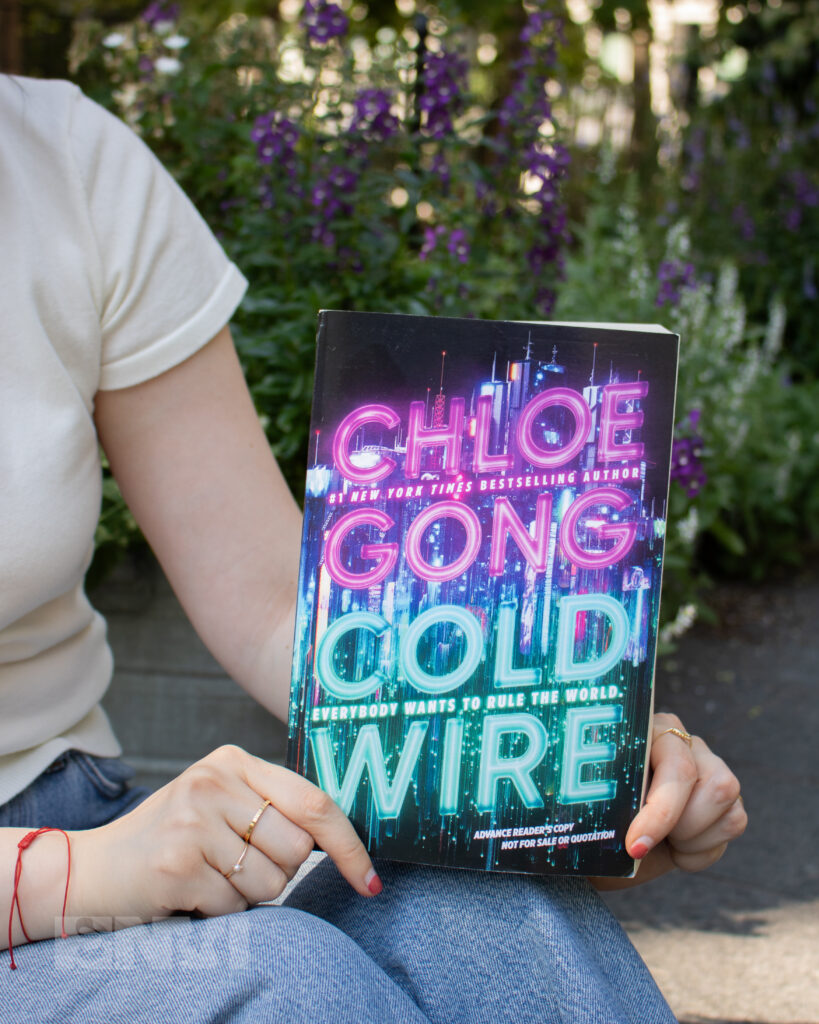
This opening scene took a while to nail down, but Gong explained that the rooftop scene was always there. Although it used to be the actual beginning of Coldwire, a character soaking in the city and its shiny lights is a classic way to establish the cyberpunk feeling. As Gong noted, cyberpunk is “truly an examination of what it means to be part of a city.”
The author considers herself to be a “very linear writer” and someone who “[doesn’t] jump around” when she’s writing. When faced with plot challenges, however, her answer is simple: time to rewrite. “Sometimes [it] just takes time to work out the knots,” Gong said.
There’s another method the writer relies on to untangle the plot knots. As she described to EnVi, she will lay out the chapters she’s working on and write a summary of what happens in each. Afterwards, she will color code each chapter based on the plot point it’s contributing to. Having this “visual representation” is a must when Gong’s complicated book ideas show their complicated-ness, something she herself poked fun at during our conversation.
But it pays off in the end. Coldwire’s world building is a prime example. “Upcountry” and “Downcountry” have a clear division baked into their names. But the separation found between the two, which seems simple and harmless at first, then spreads throughout the rest of the novel. This inequality builds and compounds throughout all aspects of Gong’s characters’ lives, from their career options to their last names. It becomes more and more sinister in quiet ways, so that it becomes accepted as the way the world just is.
However, Gong didn’t create the world of Coldwire by dumping every minute detail about Upcountry, Downcountry, Atahua, and Medaluo into the story. “If it was anything that was relevant, it made it in,” Gong explained. “If it was irrelevant, I just fully cut it.”
She remembered debating over small world building details like having satellites in Downcountry but not always having the full images make it into Upcountry. At the end of the day, if a detail was to make it into Coldwire, Gong needed to ask herself two important questions: Does it serve the story? Does it push the story forward?
Coldwire has one exception, thought. In one chapter, readers discover how people in Upcountry reset their existence in this virtual reality. In fact, this method might be a bit of a headache.
This reset methodology was the “one piece of technology that my boyfriend disagreed with,” Gong noted, although there was a mischievous gleam in her eye when she remembered what she added into her fictional world. Her boyfriend argued they probably wouldn’t code it like that. Gong shot back with a satisfied smirk in her voice, “I think they will code it exactly like that because it’s easy.”
How Do We End Up Where We Are?
Coldwire may be a cyberpunk story focused on the future of a technologically-advanced society, but it also prioritizes how the ordinary person loses pieces of themselves to giants who benefit in every way. There is an undercurrent questioning the “trading and exchanging of bodies” in the novel.
Both Lia and Eirale are Medan orphans who spend most of their lives in the Nile Military Academy in Atahua. To better understand an adoptee perspective — which is a subtle yet recurring aspect in Coldwire — Gong said she turned mostly to personal essays. “How do I make sure these characters feel informed by this part of their situation without making it just an archetype?”
As to why Gong chose to include an adoption element in Coldwire, she noted that this “element [is] really interrogating how these people end up where they are.” According to their world, they possess the identity of the “enemy,” an identity the state has decided is dangerous for everyone else’s safety. Yet Lia and Eirale — and other characters caught in this sticky web — “do not really have a say,” Gong added. “Because they are young.”

Young people might be struggling through similar questions Gong poses in Coldwire. As a novel written for these young readers, it hopefully provides a safe place to navigate these questions. It’s a place where these struggles, like living in a world that relies on technology and questions of citizenship, are reflected and validated.
Now that Coldwire is on shelves around the world, Gong is working hard on its sequel. The interweaving storylines will continue eventually to be the Coldwire trilogy (series name pending). But just because readers may have turned the last page on the November-released novel, it doesn’t mean that all hope is lost. In Gong’s eyes, Coldwire is especially meant to be re-read to pick up on foreshadowing as well as create even clearer connections between the story and the larger themes at play. “I really hope people re-read Coldwire,” she said.
But if you are looking for a small taste of what’s next, the author had a little bit to tease. “[It’s] my signature Book Two formula, where you just hit the ground running immediately,” Gong shared with EnVi. “The characters are having the worst time of [their] lives,” she added, a tiny bit gleefully.
Coldwire is available where you get your books. Keep up with Chloe Gong on Instagram, TikTok, and X. Find more information about Coldwire and Gong’s previous books on her website.
Want to read more interviews with your favorite authors? Check out EnVi’s conversation with YA author June CL Tan here!