Lunar New Year, observed across many Asian cultures, signals a fresh start and the arrival of spring. Celebrated across East and Southeast Asia and throughout the global diaspora, the holiday is rooted in reunion, ritual, and renewal.
For many, Lunar New Year unfolds in layers of tradition and adaptation. Its inherited customs and personal touches — from family dinners to red envelopes and wishes for prosperity within the year ahead — are passed down through generations. It’s the recipes handed down, the holiday parades in new cities, and the community gatherings that keep the celebration alive each year.
From vibrant lion dances in Los Angeles to the annual parade route in New York, celebrations are unfolding across the cities Team EnVi calls home. As a team spread across communities, EnVi is highlighting the events, traditions, and local moments we’re most excited about this season, and how we’re charging into the Year of the Horse.
Los Angeles, California
In the bustling state of California, besides its Hollywood history and its surprisingly cold beaches, the city of Los Angeles is also known for its melting pot of Asian cultures. L.A. residents and tourists alike gather together to observe Lunar New Year with parades and festivals, celebrating the collection and mixture of cultures. Amongst numerous events held in honor of 2026’s Year of the Horse, the USC Pacific Asia Museum kicked off their newest exhibition, Mythical Creatures: The Stories We Carry with its annual Lunar New Year Festival. The exhibition opened February 14 and will run until September 6.
Photos courtesy of Phoebe Ahn.
The exhibition shares the history of the immigrant experience through its array of unique artworks in each of its twelve walk-through galleries. Each gallery is inspired by a shared belief, event, or experience of Asian communities, celebrating the people’s enduring sense of collective identity. The pieces within the galleries range from traditional ceramics, such as the Ginger Jar with a Qilin design from the Qing dynasty, to modern installations like Lauren YS’s Nine-Tailed Fox on lenticular print.
The exhibition concludes with the museum’s gift shop and courtyard. Visitors can write down and tie their new year’s wishes to the branches of a money tree, and enjoy a koi pond complete with pine trees and a crossing bridge — motifs in traditional East Asian courtyards and gardens. Lunar New Year brings together the collective Asian community to reminisce on how culture may have changed over the centuries, but still carries its roots, now celebrating and sharing the communal tradition with other cultures.
— Phoebe Ahn, Culture Writer
New York City, New York
Chinatown’s Super Saturday
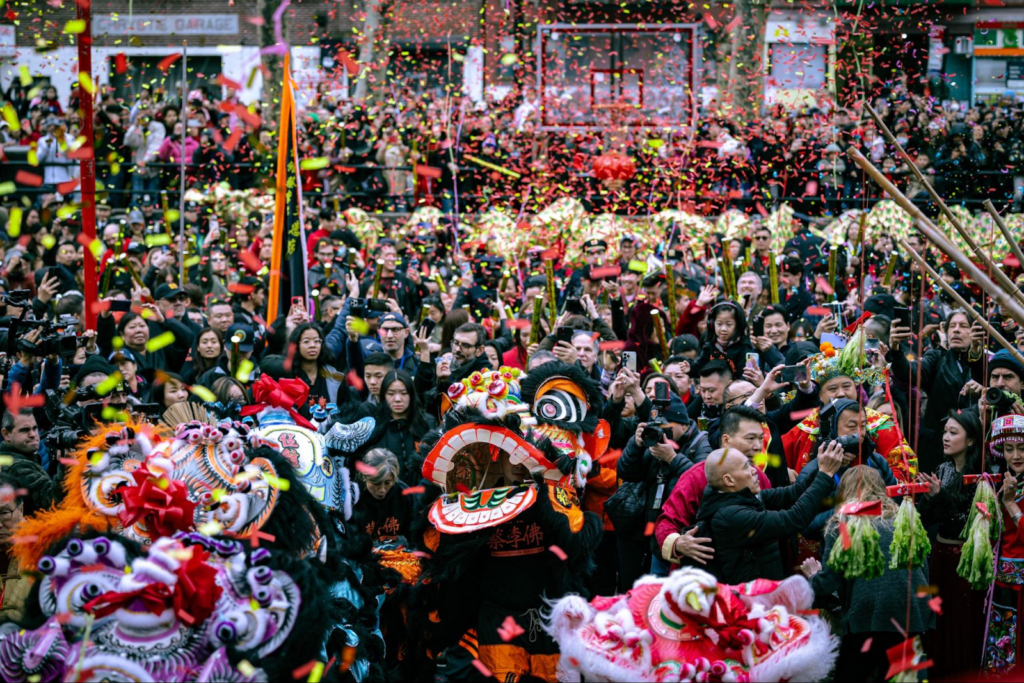
In New York City’s Chinatown, Lunar New Year takes on its own spirited tradition with “Super Saturday,” where lion dance groups make the streets their very own stage. This year, the celebration kicks off Saturday, February 28, 10 a.m. – 5 p.m. Over twenty troupes will “bless” neighborhood businesses to usher in good fortune and prosperity for the year ahead. Visitors can enjoy the lively festivities while savoring dishes inside local restaurants where lions weave through crowds and tables and workers offer them red envelopes. It is an unforgettable encounter with the neighborhood’s vibrant tradition. Confetti-lined streets, reverberating drums and gongs, and the occasional burst of firecrackers create an infectious energy that perfectly captures Chinatown’s vibrancy, community, and celebratory spirit.
— Ann Estaris, Culture Writer
NYC’s Vietnamese Tết Festivities
FifthSip, a cozy coffeeshop in Nolita dedicated to bringing Vietnamese coffee culture to the bustling city, is hosting a “Waffle Pop-Up” from Friday, February 20 to Sunday, February 22. Every Vietnamese person will know the warm, fragrant aroma of bánh kẹp lá dứa, pandan waffles that are served hot and fresh on the street, in food courts, and at every temple event. FifthSip will be serving a menu of pandan mochi waffles, Vietnamese coffee mochi waffles, and xôi mặn (a savory sticky rice), from 9 a.m. until they’re sold out!
Joy Flower Pot and Viet Salon NYC are teaming up to bring a Tết celebration that welcomes Joy Flower Pot’s grand opening of their new flower shop and café in Williamsburg. On Saturday, February 21, 12 – 6 p.m., a daytime artist market featuring Vietnamese creatives, food, and small businesses will be open to the public. The evening Tết party will close out the night from 6 – 9 p.m., boasting performances, comedy acts, and special programming.
– Cindy, Culture Writer
Dajia District, Taichung County, Taiwan
Around Taiwan, colorful paper lanterns hang above busy streets and zooming scooters. People refresh the red banners outside their doorways, the bright color causing the swoops of calligraphy to stand out even more.
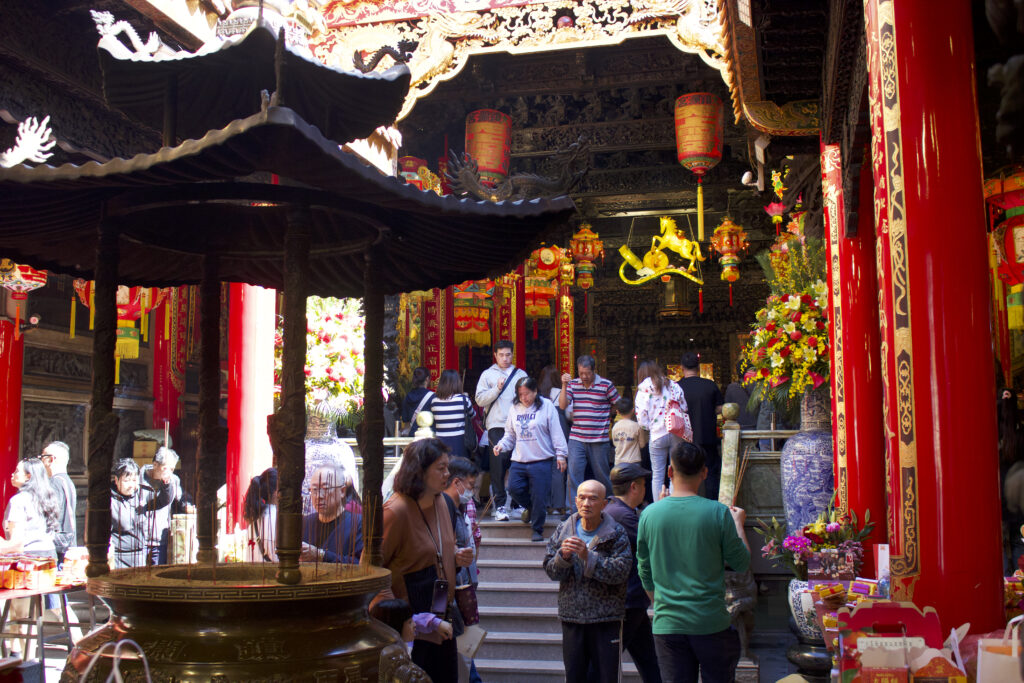
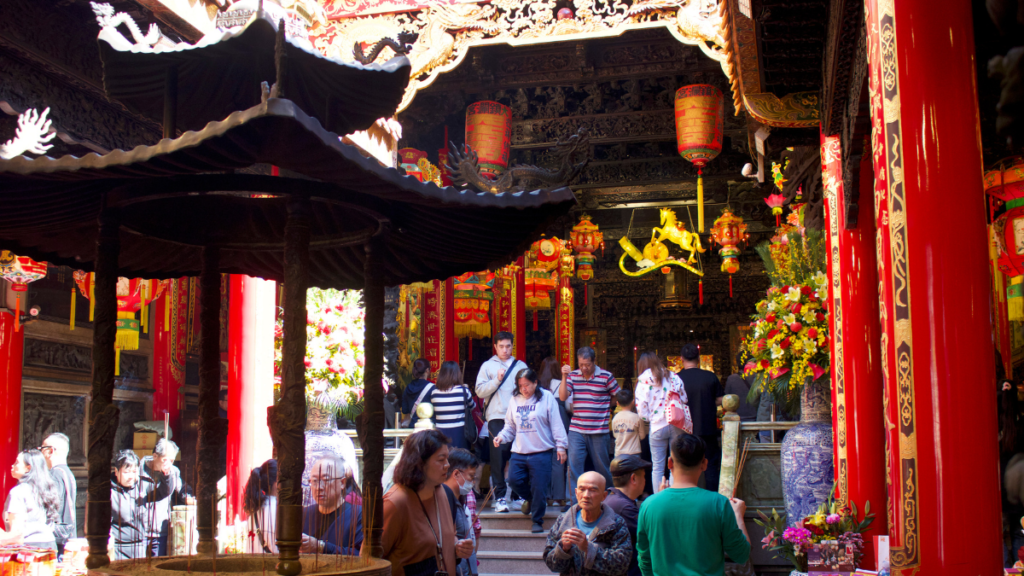
But there’s one place that’s especially bursting with life ahead of and during the Lunar New Year: Dajia Jenn Lann Temple. Situated in the central Taiwanese county Taichung, about an hour on the High Speed Rail from Taipei, this temple is a bit different from your usual neighborhood one. Founded in 1730, Dajia Jenn Lann Temple is home to the Dajia Mazu, the Goddess of the Sea. Although Mazu migrated to Taiwan with Fujianese immigrants in the 17th century, she is now one of the most revered deities in Taiwan. The largest annual Mazu pilgrimage also begins at this temple, as devotees walk with the Dajia Mazu from Taichung all the way down to the southern county of Chiayi. Although you don’t have to walk the whole way, the entire pilgrimage takes the Dajia Mazu nine days to complete.
During the Lunar New Year week, the temple is full of life, color, and offerings for the gods. When I went on Little Lunar New Year Eve (小年夜, xiǎoniányè,) there was just enough space in its halls and courtyards to move around. Yet, it was still packed with people doing 拜拜 (bài bài) — or praying to the gods — setting out joss paper and other offerings on red tables, or asking for new year blessings in front of the temple’s central censer. Here at the temples in Taiwan, you can truly understand that the new year has arrived.
— Sara Conway, Digital Editor
Manila, Philippines
At the oldest Chinatown in the world, founded in 1594 by Chinese settlers, Manila’s Binondo bursts into a sea of vibrant red and gold as Lunar New Year approaches. Paper lanterns sway above narrow streets and restaurant and shop windows glow with gold accents, as people flock to the district. Centuries of trade, migration, and a shared history have created a cultural crossroads where Chinese and Filipino traditions intertwine — seen not only in cuisine, but in family traditions and community life.
To commemorate the new year, tourists and locals alike weave through the famed streets of Yuchengco and nearby Ongpin, where long-standing establishments hang auspicious decor and host lively dragon and lion dances believed to drive evil spirits away, while street food vendors add to the festive bustle. Alongside this, Binondo serves not just as a commercial hub, but as a spiritual and cultural center for the Filipino-Chinese community.
A staple among Filipino-Chinese families (and embraced in many Filipino households) is tikoy, known as nian gao (年糕) in Mandarin. Enjoyed during Lunar New Year, the sticky rice cake symbolizes growth and prosperity, while its glutinous texture represents strengthened unity and familial ties. While red boxes of tikoy are stacked high in shop windows across Binondo this time of year, one name has become synonymous with the delicacy, Eng Bee Tin. Founded 114 years ago as a modest stall, the shop is best known for preserving traditional Chinese confections while introducing Filipino flavors — from classic white and brown sugar tikoy to ube, pandan, and salted egg varieties — making it a popular Lunar New Year gift each year.
— Ann, Culture Writer
Jakarta, Indonesia
A city steeped in history, many in the Chinese diaspora have called Jakarta home since its colonial days centuries ago. It’s natural, then, that Chinese culture is woven into the Indonesian capital’s cultural tapestry. This year, many landmarks and iconographies are lit up in hues of red and gold as the Lunar New Year celebrations arrive in the city.
The city’s most iconic roundabout, Bundaran HI, is decked in 3D lanterns shaped after the 12 animals of the Chinese zodiac, paired with an electric lion dance performance. Further west, Jakarta’s most famous Chinatown, Glodok Pancoran, comes to life with the bustle of families of all ages flocking to the Chinese-Indonesian-owned eateries. There — and in households throughout the city, really — dinner tables brim with a spread of Chinese-influenced fare that have been adapted through cultural assimilation and combination. Referred to as Peranakan cuisine, it’s a result of Chinese immigrants who settled in Southeast Asia, merging their food with the localities of Singapore, Malaysia, and Indonesia. Among these foods is lapis legit, a supple Dutch-inspired layered cake spiced with earthy, Indonesian spices; and an iteration of the Taiwanese pineapple cake, nastar.
Still, the hallmark of Lunar New Year celebrations in Jakarta is the tradition of family gatherings and sharing those foods at home. It’s one of the only times each year you’d get to meet your grandfather’s uncle who lives in a different city, or the second cousin who went to school abroad and has since emigrated. Red envelopes are handed out, several rounds of capsa (a card game also known as big two, deuces, or Chinese poker) are played, and fireworks light up the sky come sundown.
— Quinn, Music Writer
To keep the momentum going in the new year, explore these Year of the Horse song recommendations from EnVi’s Music team!