The Cheonmachong Silla Crown: A Symbol of Korea’s Golden Age
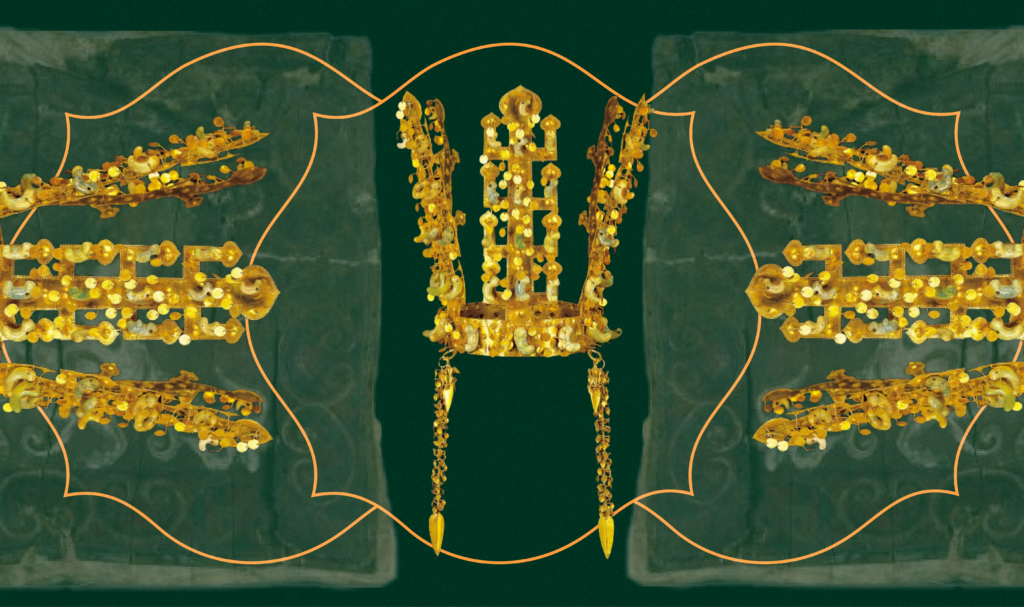
On October 29, 2025, during the APEC summit held in Gyeongju, South Korea, US president Donald Trump was presented by South Korean president Lee Jae-myung the Grand Order of Mugunghwa along with a replica of a golden crown. This event elicited a range of reactions from confusion to curiosity, bringing renewed global attention to one of Korea’s most significant historical artifacts. In conjunction with the summit, the Gyeongju National Museum hosted an exhibition called “Silla Gold Crowns, Power and Prestige” from October 28 to December 14, displaying the original crown with its five other sibling regalia for the first time in 104 years.
For many South Korean citizens, the online landscape was quite a phenomenon. The event prompted widespread online discussion over the secret meaning behind this ancient Korean artifact – for the golden crown presented was not a replica of just any crown. The crown, named Cheonmachong Geumgwan (천마총 금관), or else known as the Heavenly Horse Gold Crown, is one of six crown relics left of the Silla dynasty. Dating back roughly 1,500 years, this crown carries a rich history, and consequently, deep political and symbolic meaning; it was the representative of the Golden Age of Korea.
Discovering Divine Artifacts of the Dead
The Silla crowns have essentially become emblematic of the Silla dynasty, one of the three kingdoms ruling the Korean peninsula around the first century. The kingdom of Silla stood from 57 BC to 935 AD, lasting nearly a millennia, making it one of the longest-lasting ruling dynasties in history.
One of the most prominent characteristics of the Silla kingdom was its seeming obsession with gold. From the famous legend of Park Hyeokgeose being born from a golden egg and becoming the first king of the Silla Kingdom to the numerous golden artifacts found in the tombs of present day Gyeongju, archeological findings and preserved mythologies suggest that gold played a heavy role in elite Silla culture. As gold became concentrated amongst the ruling class, kings were given the title “Maripgan” (마립간) or “the highest position,” and this precious metal became a symbol of divine and royal power. Discovered alongside a myriad of other precious treasures, the Cheonmachong crown was excavated in 1973, in the royal tomb of either King Soji or King Jijeung. The tomb and the namesake of the gold crown were inspired by the murals of the divine flying horse, Jangni Cheonmado (장니 천마도), painted on the walls of the tomb.
The Cheonmachong crown was constructed out of pure gold, roughly 32.5 centimeters (12.8 inches) tall, featuring three lines forming the Chinese character for mountain (山) in the front and two branching antler-horn-shaped motifs in the back, somewhat resembling the tines of later European crowns. These three-tiered structures signified the king’s divine, shamanistic role, the link between heaven and earth. A total of 58 curved jade beads (곡옥) adorn the crown’s structure. The shape resembles the modern Taeguk sign, a symbol of yin and yang, and the jade stone, a symbol of wealth and power for the aristocracy of Gyeongju. The crown also extends downward with two heavily decorated chains that would have hung on the sides of the face.
As another golden cap was also discovered within the same tomb, but in a different location, it is suggested by scholars that this might have been worn under the main crown or completely separately. Though the debate over whether the Silla crowns were actually worn or simply a royal funerary decoration remains officially unresolved, many experts say the gold crowns were much too large and delicate to be worn by the living. In contrast, it appears more likely that they were designed specifically as a burial crown.
According to Professor Lee Han Sang of Daejeon University, the Silla people believed in a philosophy called Gaesaesasang (계세사상), the belief of continued existence. Kings of the time believed that death was simply a continuation of the present life, and the afterlife was simply an extension of the living world. Thus, tombs were built as massive structures to serve as their palaces and were filled with items that were brand new, crafted for deceased monarchs to use after they passed into the afterlife.
“As they lived with gold, after death, they covered their whole bodies in gold,” the KBS documentary Silla Royal Capital Restoration Project – The Fortress of the Golden Knights recounted in episode 1 – “The City of the Moon (달의 도시).” “Gold crowns, necklaces, belts, shoes – they were decorated in gold from head to toe. It was the dream of the Silla Kings (Maripgan) to live eternally with their city.”
Silla’s Legacy Engraved in Gold
Though the meaning of the diplomatic gift remains left to interpretation, the original Cheonmacheong crown had clear political significance in 500 AD. The Silla Kingdom was not only the longest lasting kingdom in Korean history, but it was also the first to unify the Korean peninsula after forming an alliance and conquering its rival kingdoms Baekje and Goguryeo. Moreover, the kingdom’s obvious gold culture was indicative of its thriving trade with China as well as some nomadic Scythian tribes. In fact, the Silla dynasty became so renowned for its obsession with gold, its then capital city, now modern day Gyeongju, was nicknamed “the city of gold.” The discovery of the Silla gold crowns became testament to the thriving artistry, the prosperous international trade, as well the unification of the Korean peninsula.
A millennia ago, the gold crown was a symbol of the divine authority of the Silla kings; today, the Cheonmachong crown encapsulates a bygone era of wealth and cultural development. Whether viewed as a historical treasure or a diplomatic gesture, we can appreciate its rich and complicated history as well as the artistry and preservation.
It offers a powerful reminder of Korea’s enduring heritage as one of history’s oldest crowns.
For more on cultural preservation and tradition, explore EnVi’s Guide to Lunar New Year celebrations here!