The Power of Play: How Mahjong Builds Community Across Generations
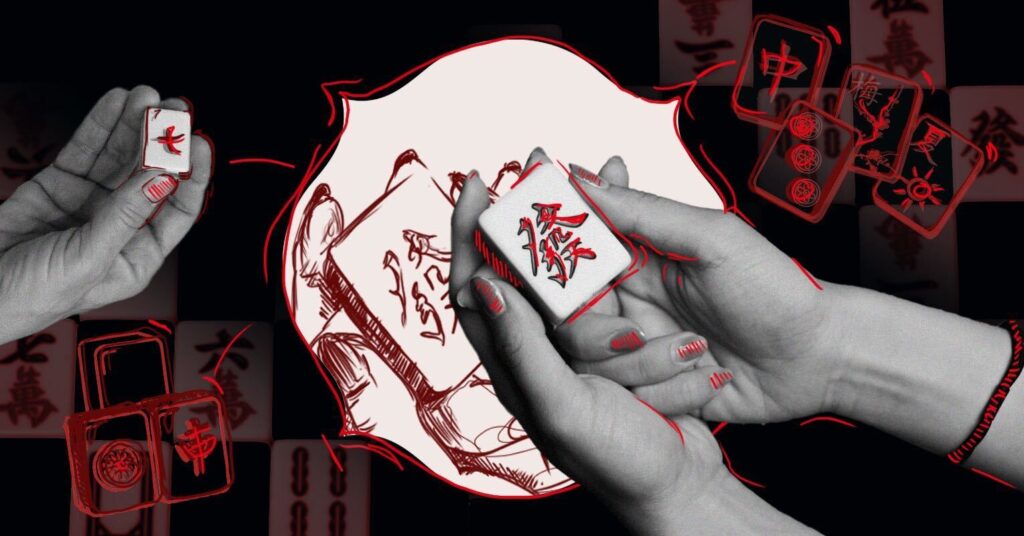
On Thursday nights in Los Angeles’ Chinatown, the clatter of tiles cuts through the hum of conversation inside General Lee’s. At first glance, it looks like any other game night, with friends squeezed around tables, drinks sweating onto coasters, the occasional cheer erupting from a winning hand. But listen closer and you’ll hear something else unfolding — jokes and jests, shorthand calls, debates over house rules. Mahjong has become its own language here, one that millennial and Gen-Z organizers are keeping alive through community-driven game nights from Los Angeles to New York City and beyond.
To understand just how the game is sparking connection and community today, EnVi spoke to Nicole Wong, whose work traces mahjong’s diasporic traditions, alongside grassroots organizers Finnegan Wong-Smith, Jaimie Wan, Matt Willard, and Cayla Zhang who host both intergenerational and open-floor mahjong nights to communities in California. In speaking with them, it’s clear that stories of learning and playing mahjong are both familiar and deeply personal. Each family has its own style, its own practices, its own traditions surrounding the game table. In cafés, community spaces, and collectives, a new generation is furthering those traditions, not just as a fun pastime, but as a bridge. As younger generations reclaim their heritage, mahjong offers a pathway to reconnect with elders and build community with one another.
A Folk Tradition, in Play
Nicole Wong, founder of The Mahjong Project and author of Mahjong: House Rules from Across the Asian Diaspora, describes the game as something closer to a folk tradition than just another way to pass the time. Wong established The Mahjong Project in 2019, both as an instructional guide and oral history endeavor, recording her family’s house rules while placing them within the flow of the game’s larger historical and diasporic evolution. Through this venture, she welcomed others to share their personal histories as well.
“Mahjong is very much like a folk tradition, like dance or food cultures,” she tells EnVi. Her research has only deepened her fascination with the game’s many variations. “The wide diversity within something like mahjong is actually unifying. The fact that we all play differently is something that brings us together.”
Like any language, Wong notes, mahjong has dialects and variations: Hong Kong style, American mahjong, among many others. Even within families, rules shift subtly: a tweak in scoring, a different name for a move, a house-specific taboo. At tournaments, Wong often sees strangers begin with the same questions: “Do you play this way or that way? What do you call this move?”
From there, a quiet excavation occurs. You can begin to piece together where someone might be from, or what their family history or migration story looks like. “I find it forever fascinating that something physical and tangible, like a game, can reveal things about an individual history,” she says.
For many in the diaspora, especially those whose parents or grandparents prioritized assimilation, those nuances take on new meaning. The game becomes an accessible entry point into oral history, a way to ask elders not just how to play, but where, why, and (if you’re lucky) how, they learned. Wong says, “It’s a reason to get together, and so it’s a way for some of those community ties to hold.”
The Table as An Equalizer
At the table, hierarchies slightly soften, even if only for a spell of time. Wong notes that intergenerational play, in particular, can feel surprisingly democratic. “When you play mahjong with a grandpa or a kid, everyone’s more on the same page,” she explains. “At family parties, there’s very established hierarchies [and] ways that you’re interacting with people. At the mahjong table, that can change up a little bit, which is fun and memorable. If you beat your grandma at a game, that’s a big deal.”
For some, this resurgence also carries a sense of reclamation. Many young players grew up watching their elders play but were rarely invited to join. The table felt exclusive, reserved for adults who spoke in the language of the game, only partially understood. Learning and playing the game now can feel like crossing a threshold of sorts. Participation becomes belonging, and today’s younger-led collectives are intentionally widening the circle, making space for peers and elders alike.
In Asian households across generations, mahjong has long anchored family parties. Food fills the table before gameplay begins, with snacks circulating mid-hand. Wong notes that even the slang of the game mirrors eating (winning a hand is described as “eating a big hand,” for example), and the parallels aren’t accidental. “When you’re playing mahjong, you’re gathering around the table and talking and chatting,” she says. “It feels really similar to sharing a meal.”
For younger players who grew up watching from the sidelines — seeing grandparents play but never being invited in — learning the game now offers a chance at new dynamics and ways of engaging with each other. Here, participation becomes belonging.
Building a Third Space
After COVID lockdowns were lifted, many young adults were hungry for connection beyond work and home — they were in search of a third space to gather. That desire helped propel grassroots groups like Mahjong Underground in Los Angeles, where weekly games offer both ritual and refuge.
For co-founder Finnegan Wong-Smith, the idea began with a personal reframing. Growing up, he watched his grandparents play, but never fully considered the context. “You see your grandparents playing,” he says. “I never thought about [how] they were doing it to spend time with their family, as a form of community and socialization, not just gambling.”
What he wanted was a space where anyone could share a table, and where young people could form connections outside of work and typical nightlife. In 2023, he began attending local weekly games hosted by an earlier grassroots collective, Lowheads Mahjong, simply to meet new people. “It puts you in front of new people and puts you across them,” he says, “and then when you have downtime, you get to talk.” The consistency — same time, same place each week — allowed a sense of community to crystallize. When Lowheads Mahjong Club ceased operations, Wong-Smith stepped up to carry their momentum forward; from there, Mahjong Underground was founded in 2024.
Since then, they’ve hosted weekly open floor nights, Mahjong & Chow gatherings, holiday events, and a well-loved Intergenerational Mahjong Series, all grounded in the simple purpose to serve the community and play.
“At the end of the day, even if we didn’t have food or drinks, [it’s] now able to run itself,” says co-organizer Jaimie Wan. “It’s because of people being consistent and showing up. It’s the atmosphere of wanting to learn and teach each other.”
Choosing Chinatown as a home base was deliberate. When they began, hosting their events at General Lee’s meant supporting a neighborhood already layered with history rather than manufacturing a rebranded aesthetic. The red lantern glow and familiar décor didn’t need to be staged, they were already part of the cultural landscape.
Their growth has been organic since their inaugural game night, and surprisingly diverse. While largely 21-plus, the age range spans early twenties to millennials, sometimes with elders and even babies in tow depending on the night. From there, new social circles form naturally around the tables. “It’s interesting getting to hang out with people I wouldn’t normally meet outside of work,” Wong-Smith says. “You see all these little groups forming based on shared interests
Some connections extend even beyond the game itself, from camping trips to new friendships carried into other corners of the city. At one Thursday gathering, a family of cousins regularly brought their grandmother, who played until nearly midnight.
For both Jaimie and Finnegan, what makes the space meaningful isn’t scale but resonance. “We [always] have to ask, ‘what are we trying to do in line with our mission?” Jaimie says. “What makes it meaningful? Is this something the community actually wants?”
The feedback they’ve received has been its own affirmation. Introverted friends show up alone and leave with new connections, younger players sit across from elders and find common ground. In a city that can feel sprawling, the table becomes a point of return, a place where belonging is practiced, week after week.
A Ripple Effect
For Jaimie, helping run weekly events and pop-ups has been as personal as it is communal. “Growing up, I actually was not proud to be Chinese-American,” she says, “I had this whole ‘I’m American, I only speak English,’ so I did lose a part of my like heritage [and] my culture because I was ashamed of it…But over the years, and as I’ve really embraced my own heritage, I now see like mahjong as a way to celebrate that and share that with different people.”
That spirit extends to the group’s Intergenerational Mahjong series, launched in partnership with the Greater Los Angeles chapter of OCA-GLA and initially hosted at a senior center in Monterey Park. What began as a five-event experiment funded by a community grant grew into a recurring monthly program, drawing as many as 150 attendees, from infants to players in their 80s.
At first, younger participants were worried seniors would find them “too slow” to play with. Instead, they found some elders who had never played before, either. Meanwhile, younger regulars (including players who learned through weekly meetups) stepped into teaching roles.
Over time, the local senior center became an informal classroom, where experience mattered less than a willingness to learn. Language barriers softened over character tiles and winning moves, and even the game’s rules — however nuanced — became a shared framework. While some didn’t share a mother tongue, cultural background, or heritage, Jaimie adds, “Our common language was mahjong.”
A Shared Language
For millennials and Gen Z players, gathering around the table is not nostalgia, instead it’s a reshaping of their relationship with a game they might’ve grown up with. It’s an active reclamation — a way to connect with elders, with heritage, with family stories — through the simple act of shared play.
Creating one community space often sparks another. When participants experience belonging around the table, they begin recreating it elsewhere — hosting their own game nights, teaching roommates, inviting younger family members who haven’t yet learned the house rules.
For a generation that may have inherited fragmented relationships to language or tradition, mahjong offers something tactile and more immediate. Fluency is not needed to play, instead what’s needed is patience, attention, and a willingness to sit down.
And, in sitting down to play, something special unfolds. You may learn the rhythm of your grandmother’s strategy. You could hear how your dad used to watch his parents play late into the night. You might argue (affectionately) over rules that actually reveal once-hidden memories. Through play, stories surface that might never surface in an everyday conversation.
Mahjong is not being repackaged so much as it is being reignited. Its nuances, as Nicole Wong says, are to be “celebrated” rather than just standardized. Its variations become conversation starters instead of (or alongside) points of division.
Looking for more ways to celebrate culture and community? For more traditions, history, and modern reflections, explore Team EnVi’s guide to Lunar New Year.